We use cookies to improve your experience and understand how PatternDesigners is used.
Marc Cain is a German premium women's fashion brand founded in 1973 by Helmut Schlotterer in Carpi, Italy - then one of Europe's leading knitwear production centres in Emilia-Romagna. In 1976, Schlotterer returned to Germany to take over his father's struggling knitwear factory in Bodelshausen, Swabia, which became Marc Cain's permanent production home and headquarters. The brand is positioned as one of the few German labels in the international upmarket fashion segment, known primarily for elaborate knitwear, strong print design - particularly leopard prints - and a proprietary textile printing process called INJEKT, developed in-house from 1998. As of the source date, Marc Cain delivers to 29 countries through e-commerce and operates an international store network.
Helmut Schlotterer founded the brand and has remained its creative and commercial leader through its 50-year history. The brand's signature aesthetic - elaborate knitwear, leopard prints, bold colour, the Coordinates mixing concept - has been sustained and developed across multiple decades and label extensions. No named head of design beyond Schlotterer is documented in the source. The store concept (2005) uses a restrained spatial language - steel, aluminium, white acrylic glass, light grey, metallic silver, mint green - designed to give the fashion itself visual primacy.
Marc Cain's growth from a Carpi knitwear startup to a multi-label premium fashion brand spans 50 years. Key milestones:
Marc Cain operates several labels:
Marc Cain operates through its own stores and selected retail partners internationally. The first store opened in Mainz in 1986. The Cain City factory outlet (700+ sqm) opened in 2008 near the Bodelshausen campus. Online retail launched in 2011 and delivers to 29 countries as of 2024, with a 2024 expansion adding Bulgaria, Denmark, Greece, Croatia, Luxembourg, Norway, Romania, Sweden, and the USA to the e-commerce footprint. The logistics centre (2014) has capacity for 1.4 million palletised items and 460,000 hanging garments, supporting the international fulfilment operation. Marc Cain's TV advertising (6-second GIF format, 2014-2019) was an early example of short-form digital-adjacent broadcast advertising in German fashion.
Marc Cain operates in the German and international premium womenswear segment, competing in the upper contemporary to accessible luxury tier. The brand's identity rests on knitwear expertise, a distinct print language (particularly leopard prints), and the "Coordinates" concept - which the brand defines not as matching separates, but as an intentional clash of seemingly different pieces that together form a coherent "Marc Cain look." The brand has built an international retail presence and delivers to 29 countries via e-commerce. Its German origins and integrated manufacturing in Bodelshausen - including an in-house advanced knitting factory described as one of the most modern in Europe - are part of its positioning.
Marc Cain is commercially significant to surface pattern design for two distinct reasons: its proprietary printing technology and its distinctive print identity.
INJEKT printing process - Marc Cain developed its own inkjet textile printing process in 1998, at a time when screen printing and rotary printing were the industry standard. The INJEKT process allows printing on a wide variety of materials including alpaca, wool, viscose, and cotton, and can reproduce patterns on fully fashioned and 3D-knit constructions - a significant technical capability that conventional textile printing methods could not achieve. The process has been continuously developed over four generations; the current (4th) generation expands the CMYK colour space to 10 colours and delivers a 260% increase in production efficiency over earlier versions. This represents a meaningful in-house technical innovation in textile surface printing that gives Marc Cain independent control over its print design output across unusual textile substrates.
Leopard print is explicitly identified in the source as one of Marc Cain's defining design signatures: "special leopard prints" are named alongside knitwear as the brand's most characteristic product output. As a premium German brand, Marc Cain's sustained commercial commitment to leopard print represents one of the more sustained European fashion investments in this pattern category.
Coordinates concept - the Marc Cain "Coordinates" philosophy, developed through the 1990s, is built on intentional pattern and colour clash: different patterns and materials brought together to create a unified but tension-filled look. This is a design philosophy centred on surface pattern interplay rather than uniform matching - commercially relevant to how Marc Cain develops seasonal print families and fabric combinations.
Marc Cain Glam (FW2024) introduces "sumptuous prints" alongside sequin embellishment as a dedicated occasion-wear category - extending the brand's print focus into a surface-embellishment direction.
AI campaign (FW2024) - the "Blend Boundaries" campaign generated digitally created colourful floral fields via AI, positioning Marc Cain as an early adopter of AI-generated surface imagery in fashion marketing.
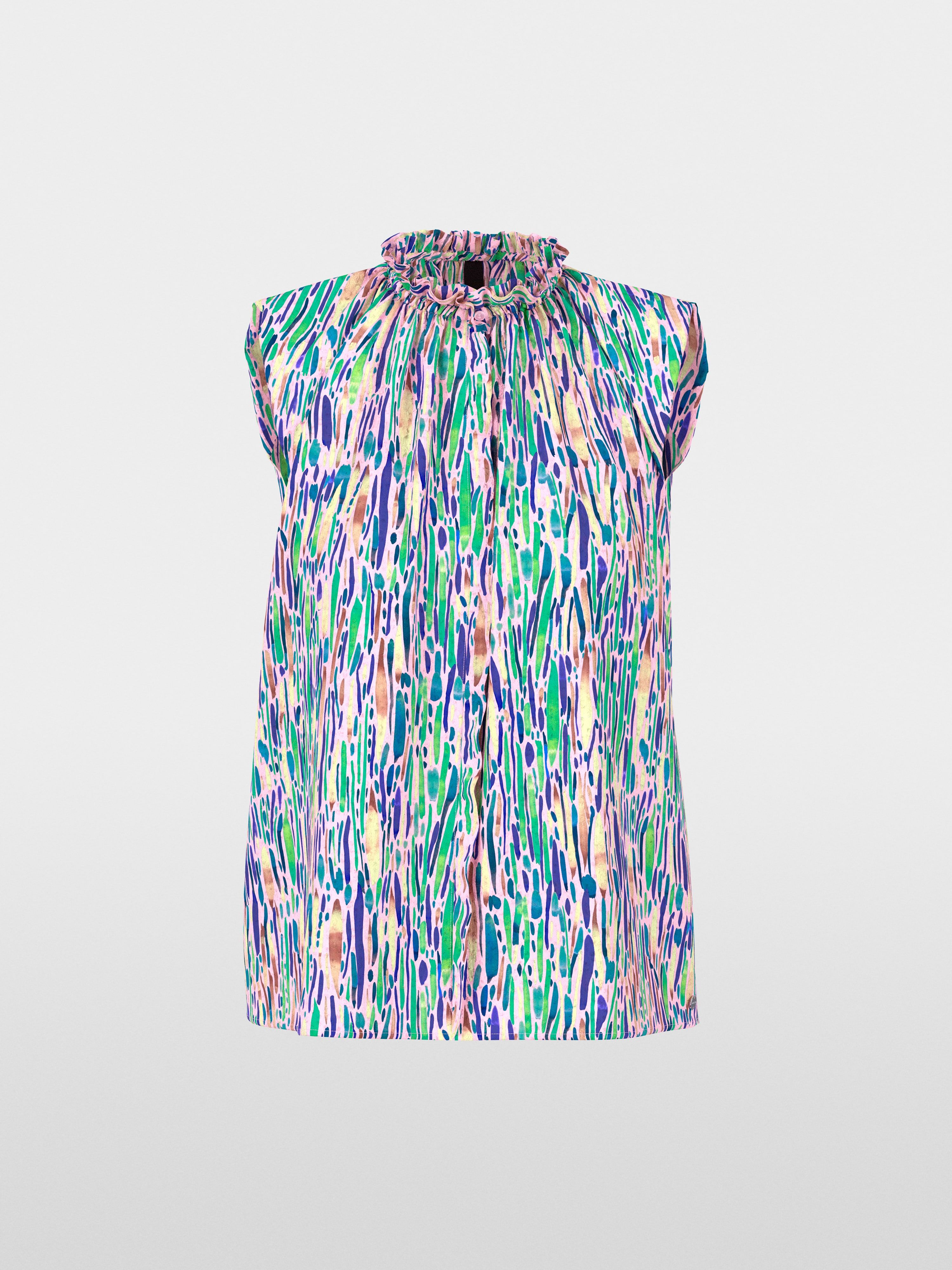
Marc Cain is a German premium women's fashion brand founded in 1973 by Helmut Schlotterer in Carpi, Italy - then one of Europe's leading knitwear production centres in Emilia-Romagna.
Marc Cain is commercially significant to surface pattern design for two distinct reasons: its proprietary printing technology and its distinctive print identity.
Marc Cain operates in the German and international premium womenswear segment, competing in the upper contemporary to accessible luxury tier. " The brand has built an international retail presence and delivers to 29 countries via e-commerce.
Marc Cain operates through its own stores and selected retail partners internationally. The first store opened in Mainz in 1986. The Cain City factory outlet (700+ sqm) opened in 2008 near the Bodelshausen campus.
Marc Cain's growth from a Carpi knitwear startup to a multi-label premium fashion brand spans 50 years.
Germany