Types
 0Blue is among the most commercially important colours in surface pattern design. It carries strong associations with calmness, trust, and reliability, making it broadly acceptable across consumer markets. The blue-and-white pattern tradition - rooted in Islamic and Chinese ceramics and transmitted through Delftware, Blue Willow transferware, and Toile de Jouy - is one of the most persistent and commercially active motif families in home decor, tableware, and textile design. Monochromatic blue schemes remain commercially reliable across fashion, interiors, and licensing.
 0Coral pattern encompasses two related but distinct directions. The first uses marine coral organisms as literal motifs - branching polyp forms, sea fans, and reef structures rendered as conversational or abstract surface patterns. The second uses coral as a dominant colour vocabulary: a warm pinkish-orange positioned between orange and pink, applied across botanical, geometric, abstract, and figurative motif categories. Both directions share tropical and coastal associations and are commercially grouped together in resort, swimwear, and lifestyle product contexts.
 0Light blue pattern is a colour-led classification rather than a motif or structural type. Any pattern - geometric, floral, stripe, check, abstract - falls into this category when light blue is the dominant or defining colour. As a result, the category is commercially broad and crosses most pattern markets. Light blue carries strong and consistent psychological associations in Western commercial contexts: calm, clarity, trust, and openness. It is the colour of clear sky and clean water, and this associative weight makes it commercially stable across many product categories. First recorded as a colour term in English in 1915, light blue has a long commercial and cultural life in textiles, interiors, and product design.
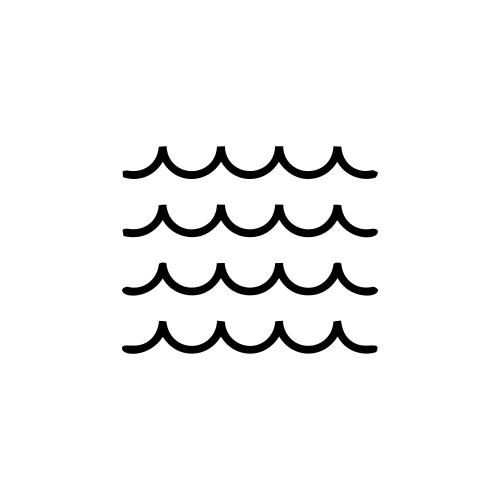 0Sea and marine patterns are among the most commercially durable categories in surface pattern design, driven by consistent seasonal demand in summer, resort, and coastal lifestyle markets. The category encompasses both naturalistic underwater imagery and more abstract or graphic nautical references, ranging from illustrated fish and sea creature patterns to simple anchor-and-rope motifs. The breadth of visual material available - from tropical reef systems to cold-water coastal settings - supports a wide range of aesthetic moods.
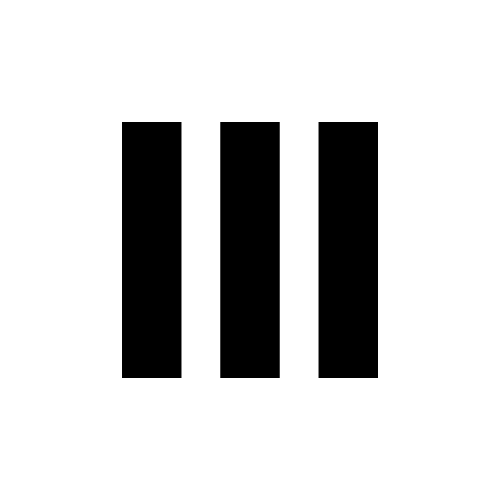 0Stripe patterns reduce surface design to its most fundamental element: parallel bands. Despite (or because of) this simplicity, stripes carry an unusually rich history of social, cultural, and commercial meaning. Their visual properties - extending the eye along a single axis, creating optical effects through proportion and contrast - have been exploited across fashion, home textiles, and decoration for centuries. Stripe patterns are among the highest-volume commercial designs in surface pattern, appearing perennially across every product category.
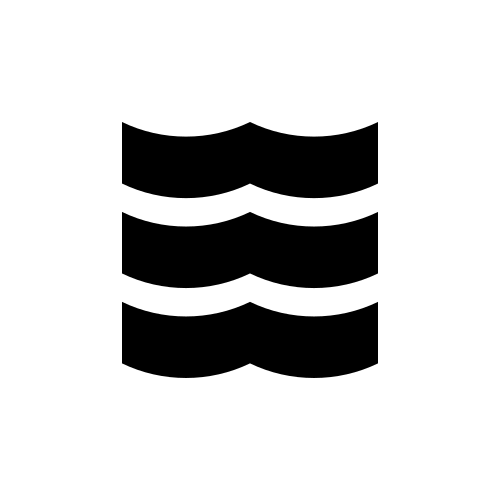 0Wave patterns draw on one of the most universally recognised natural forms: the curved, rising-and-falling profile of a water wave. In surface pattern design, wave structures range from simple sinusoidal line patterns through to complex, layered representations of ocean swells and breaking waves. The category encompasses both highly geometric, abstract wave forms and naturalistic sea imagery. Wave patterns carry consistent psychological associations with movement, rhythm, and the natural world, making them commercially versatile across fashion, home design, and digital applications.
You've reached the end
6 Types