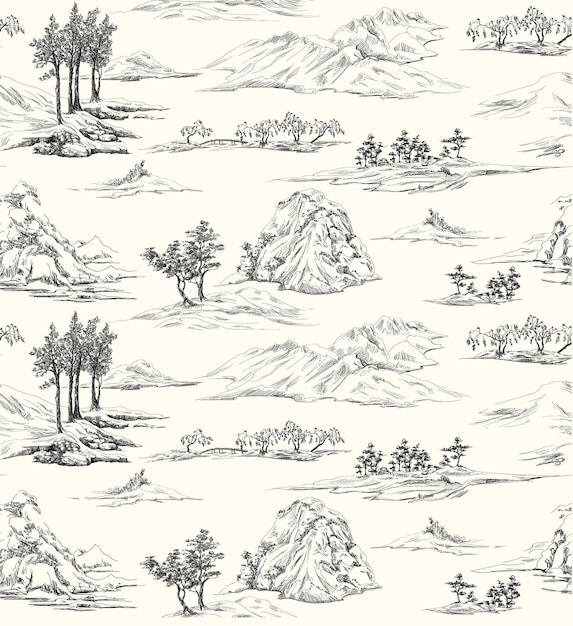
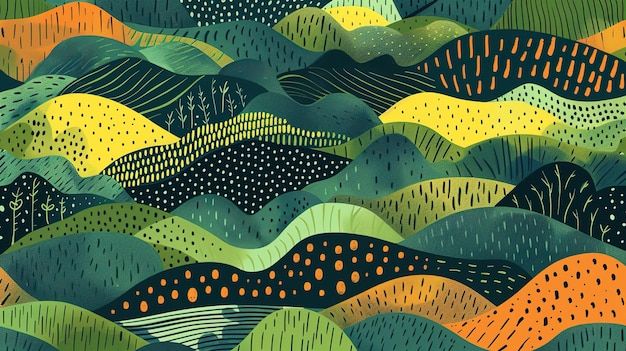
A landscape pattern is defined by its structural constraint: it has a distinct top and bottom, and tiles only in the horizontal direction. Unlike conventional all-over repeating patterns (which tile in all directions), a landscape pattern is intentionally non-repeating vertically. This makes it unsuitable for applications requiring cut-anywhere fabric but ideal for fixed-dimension surfaces - panels, screens, walls, curtains, and dividers - where the full height of the pattern is visible as a single compositional unit. The term is used by licensing libraries such as Design Pool to categorise a specific type of engineered pattern distinct from geometric (hard-edged) and organic (soft-edged, all-over) categories. The landscape pattern is the third major structural category in this classification system.
We use cookies to improve your experience and understand how PatternDesigners is used.
A landscape pattern is defined by its structural constraint: it has a distinct top and bottom, and tiles only in the horizontal direction. Unlike conventional all-over repeating patterns (which tile in all directions), a landscape pattern is intentionally non-repeating vertically. This makes it unsuitable for applications requiring cut-anywhere fabric but ideal for fixed-dimension surfaces - panels, screens, walls, curtains, and dividers - where the full height of the pattern is visible as a single compositional unit.
The term is used by licensing libraries such as Design Pool to categorise a specific type of engineered pattern distinct from geometric (hard-edged) and organic (soft-edged, all-over) categories. The landscape pattern is the third major structural category in this classification system.
Landscape patterns function as scenes or panoramas rather than as repeating motifs. Visual characteristics:
Examples from the Design Pool library cited in sources include nautical scenes, safari scenes, and aquarium compositions - all panoramic illustrations designed for specific physical applications.
The structure is an engineered horizontal repeat. The tile width determines how far the pattern extends before repeating; the tile height is the full height of the finished product or surface. There is no vertical repeat unit.
For wallpaper, this is equivalent to a mural: the design is produced at the intended wall height and width, with horizontal tiles meeting seamlessly. For privacy screens or curtains, the full product dimensions are the pattern field.
Production notes: landscape patterns require that end-use dimensions are known at the design stage. They cannot be adapted for products of different heights without redesign.
Landscape pattern motifs are drawn from their intended application context:
Landscape patterns are format-neutral with respect to palette; colour is driven by the depicted scene and intended market. Healthcare interior applications (a documented use case) tend toward calming palettes - soft greens, muted blues, warm neutral grounds. Childrenswear and residential interior applications have broader palette ranges.
Style varies from photographic realism and detailed illustration to simplified graphic silhouette. Illustrative styles work well for privacy screens and decorative panels where the pattern is viewed at distance.
Panoramic wallpaper - scenic wallpapers printed as continuous horizontal scenes covering full walls - has a long history in European interior design, with 18th and 19th century French manufacturers (Zuber, Dufour) producing celebrated scenic panoramic wallpapers depicting exotic landscapes. The contemporary landscape pattern category inherits this tradition while adapting it for digital printing and modular applications.
A landscape pattern is defined by its structural constraint: it has a distinct top and bottom, and tiles only in the horizontal direction. Unlike conventional all-over repeating patterns (which tile in all directions), a landscape pattern is intentionally non-repeating vertically.
Landscape patterns function as scenes or panoramas rather than as repeating motifs.
Fundamentals
The structure is an engineered horizontal repeat. The tile width determines how far the pattern extends before repeating; the tile height is the full height of the finished product or surface. There is no vertical repeat unit.
Landscape patterns are format-neutral with respect to palette; colour is driven by the depicted scene and intended market. Healthcare interior applications (a documented use case) tend toward calming palettes - soft greens, muted blues, warm neutral grounds.
Panoramic wallpaper - scenic wallpapers printed as continuous horizontal scenes covering full walls - has a long history in European interior design, with 18th and 19th century French manufacturers (Zuber, Dufour) producing celebrated scenic panoramic wallpapers depicting exotic landscapes.