Types
 4Asymmetry in surface pattern design refers to the deliberate avoidance of symmetrical arrangement. Rather than cancelling visual energy, an asymmetric pattern harnesses contrast, uneven spacing, and varied visual weights to create compositions that feel dynamic and engaging. It is a structural choice rather than a specific pattern style, applicable across a wide range of motif types and aesthetics.
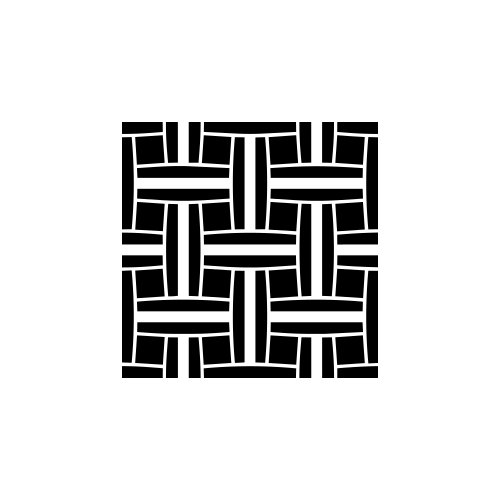 0Basket weave is one of the simplest variations of plain weave, distinguished by the grouping of threads rather than single-thread interlacing. In surface pattern design it appears both as an actual woven cloth construction and as a printed pattern that simulates the woven grid structure. Its clean geometric surface, subtle texture, and structural clarity make it commercially useful across apparel, interiors, and background surface design.
 0Brickwork pattern translates architectural masonry structure into a printed or woven surface design. In surface pattern design it functions primarily as a texture or background element, used to add structural visual interest without figurative content. The pattern appears across interiors, stationery, and fashion as a reference to urban, industrial, and heritage architectural aesthetics. It is commercially active in home decor wallpaper, printed textiles, and lifestyle products.
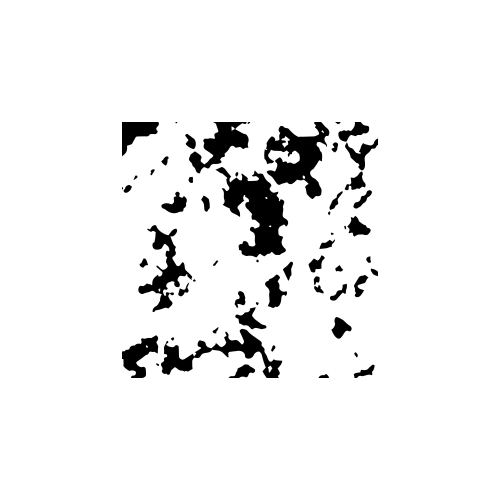 0Concrete pattern in surface design draws on the aesthetic of exposed concrete architecture - a visual language associated with Brutalism, modernism, urban environments, and industrial material honesty. As a texture reference, concrete provides a neutral, granular surface that functions as a background or structural element in surface design rather than as a decorative motif. Its commercial applications are primarily in interior materials (wallpaper, tile, printed flooring) and as a background texture in graphic design and stationery. The source available covers architectural and construction-focused concrete patterning rather than directly SPD-specific applications.
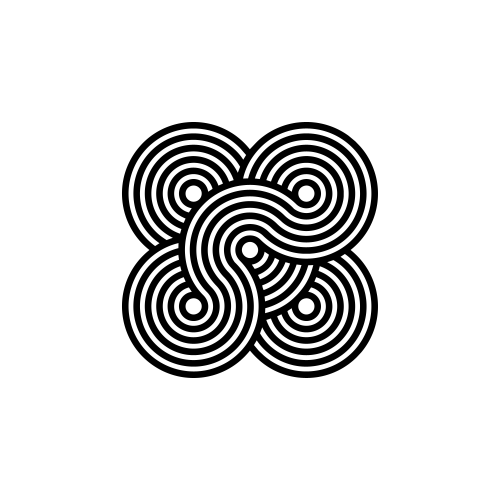 0In the context of surface pattern design (textiles, wallpaper, packaging), a designer pattern is a continuous, seamless repeat applied to the surfaces of mass-manufactured products. The designer creates a base unit - the motif - and arranges it in a systematic grid or sequence so that the edges tile perfectly when repeated. The discipline's focus is how artwork scales, repeats, and reads across physical products and surfaces. The term "pattern design" also applies in other fields - garment pattern making (structural templates for cutting cloth) and software engineering (reusable architectural blueprints) - but in the surface pattern context, it refers specifically to the visual repeat design discipline.
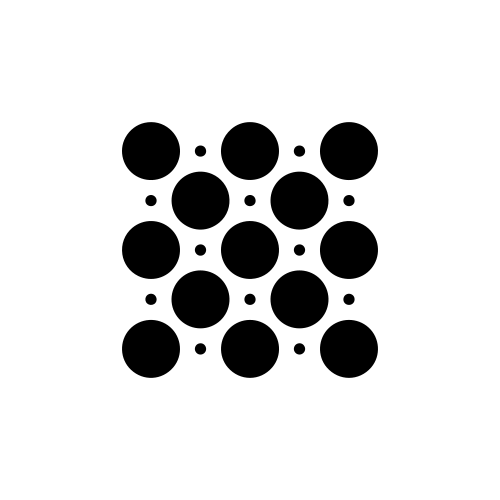 0The term "digital pattern" is used in two distinct industries with incompatible meanings. In apparel manufacturing, a "digital pattern" means a garment construction pattern (a 2D template for cutting fabric) produced using CAD software - this is the meaning addressed in the available source. In surface pattern design, "digital pattern" refers to the creation method: repeat patterns designed using software such as Adobe Illustrator, Photoshop, Procreate, or specialist pattern tools rather than by physical media. This page addresses the SPD meaning. Digital creation tools have become the dominant production method in surface pattern design. Most professional pattern designers now work digitally for some or all of their workflow - either creating artwork digitally from the start, or digitising hand-made artwork for repeat production. The rise of digital tools has expanded who can produce commercial surface pattern and has enabled print-on-demand platforms that allow individual designers to sell directly to print customers.
 0A directional pattern is one where the motifs or compositional elements read correctly only from one or a limited set of angles. Rotating or inverting the fabric makes the pattern appear wrong - animals face downward, flowers hang upside down, text becomes unreadable. This property is intrinsic to many figurative, scenic, and novelty prints and has direct practical implications for fabric cutting, garment making, and quilt construction. Directionality is a structural classification rather than an aesthetic category: a pattern is either directional or it is not.
 0A frieze pattern is any decorative design that repeats continuously along a single axis, forming a horizontal band or strip. The term comes from classical architecture, where a frieze is the continuous horizontal band between the architrave and cornice of a building facade - typically ornamented with continuous sculptural or painted decoration. In surface pattern design and mathematics, "frieze" refers to the formal class of one-dimensional repeating patterns: designs with translational symmetry in exactly one direction. There are exactly seven distinct frieze symmetry groups (the "seven frieze groups"), making this a well-defined structural category with direct relevance to border pattern design.
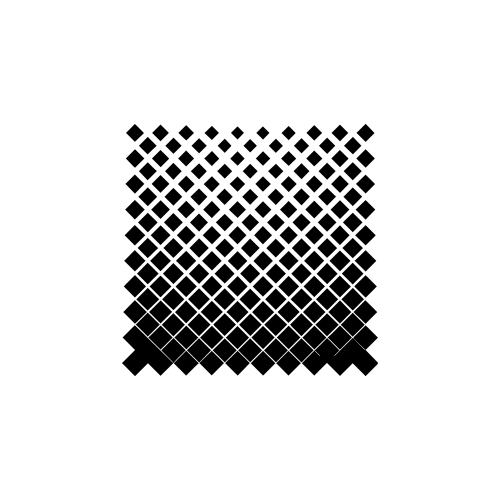 0Gradation describes the systematic progression of a design element across a surface. In surface pattern design, it appears primarily as colour gradation - the ombré or gradient effect where a hue transitions smoothly from light to dark, or one colour flows into another. Scale gradation (motifs progressively shrinking or enlarging), shape gradation (motifs morphing from one form to another), and directional gradation (angles incrementally shifting) are less common but equally valid applications. Gradation is a structural principle rather than a specific visual style: it applies across abstract, geometric, and figurative pattern categories.
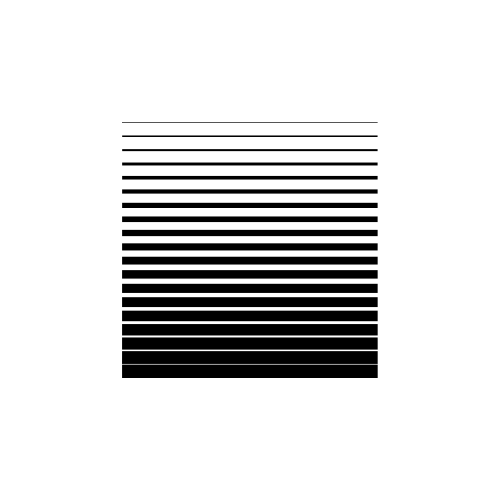 0A gradient (also called a colour gradation or degradé) is a continuous tonal or chromatic transition between two or more colours across a surface. In surface pattern design, gradients are used both as a background technique behind motif-based compositions and as the primary visual element in their own right - gradient-wash backgrounds, ombré textiles, and gradient-fill geometric patterns. The gradient technique has been used in print and textile production since the 19th century and is now a core tool in digital design software, particularly Adobe Illustrator.
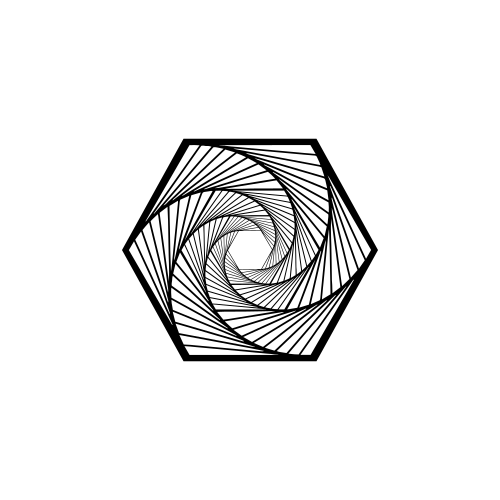 0Guilloché (from the French, after an engraver named Guillot) refers to both a machine engraving technique and the pattern it produces. The technique uses a precision lathe (engine-turning machine, or tour à guillocher) to engrave continuous overlapping geometric curves - spirals, wave forms, and interlaced circles - into a metal surface with extreme regularity and fine detail. The resulting pattern has a characteristic lace-like quality: densely regular, optically complex, and impossible to reproduce by hand. In the broader decorative arts, "guilloché" also describes the architectural motif of interlacing overlapping spirals. In surface pattern design, the guilloché aesthetic is referenced for its precision, luxury associations, and optical depth.
 0The half-drop repeat is a pattern layout technique, not a visual motif. In a straight block repeat, tiles stack in a simple grid with no offset. In a half-drop, the second column drops down by 50% of the tile height; the third returns to the original position; the fourth drops again. The result is a staggered column arrangement that closely resembles a vertical brick wall layout. Its primary commercial value is concealment: the half-drop breaks the horizontal grid that the human eye naturally detects in straight repeats, making a patterned surface read as continuous rather than as a grid of stamped tiles. It is the industry standard for fashion textiles and residential wallpaper.
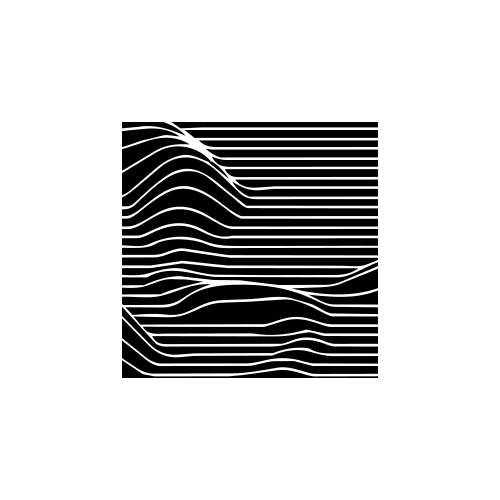 0A landscape pattern is defined by its structural constraint: it has a distinct top and bottom, and tiles only in the horizontal direction. Unlike conventional all-over repeating patterns (which tile in all directions), a landscape pattern is intentionally non-repeating vertically. This makes it unsuitable for applications requiring cut-anywhere fabric but ideal for fixed-dimension surfaces - panels, screens, walls, curtains, and dividers - where the full height of the pattern is visible as a single compositional unit. The term is used by licensing libraries such as Design Pool to categorise a specific type of engineered pattern distinct from geometric (hard-edged) and organic (soft-edged, all-over) categories. The landscape pattern is the third major structural category in this classification system.
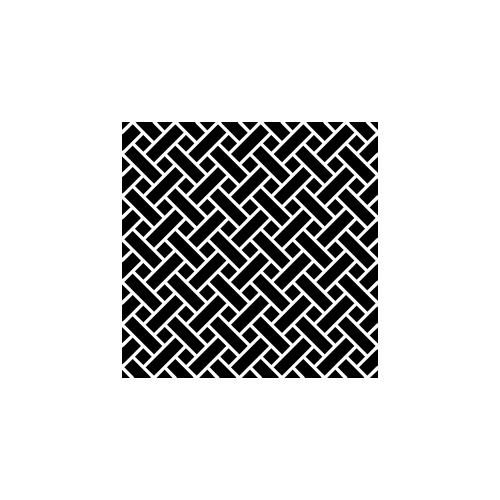 0Lattice pattern is derived from the visual and structural form of latticework - a framework of criss-crossed strips (in wood, metal, or other materials) that form an open grid or woven-diagonal pattern. As a surface pattern type, lattice uses intersecting diagonal or orthogonal lines or bands to create a regular grid with defined open areas (cells) between the crossing points. The lattice is one of the most fundamental structural patterns in surface design - it appears in tile and textile traditions worldwide, provides a compositional scaffold for more complex patterns, and functions both as a background framework and as a primary motif in its own right.
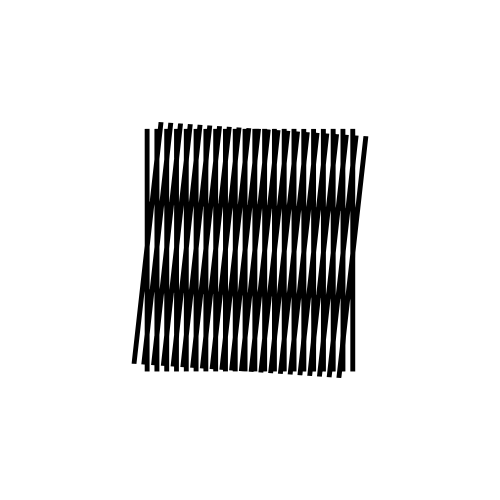 0A moiré pattern is a large-scale visual interference effect that appears when two repeating visual patterns (such as grids, lines, or dots) are overlaid with a slight rotation, offset, or scale difference between them. The visual result is a new, emergent large-scale pattern - typically a series of waves, arcs, or flowing curves - that is not present in either original pattern individually. The moiré effect is both an unintended printing artefact (a problem in halftone printing and digital photography) and a deliberately exploited optical tool in textile production, security printing, and scientific instrumentation. The term derives from the French word for a specific watered-silk textile, which produces a natural moiré effect through its weave structure.
 0Mosaic pattern refers to surface designs that either replicate or reference the visual appearance of traditional mosaic - artworks and decorative surfaces made from small pieces of coloured stone, glass, ceramic, or other materials (tesserae) set in mortar or plaster. As a surface pattern category, mosaic pattern encompasses: direct simulation of tesserae arrangements (small square or irregular coloured tile-like units); geometric tile compositions (particularly Islamic zellij and Byzantine mosaic traditions); and the broader visual aesthetic of tessellated coloured surfaces. Mosaic pattern is commercially active in tile design, printed wallpaper and fabric, and as an art-historical reference in luxury and heritage surface design.
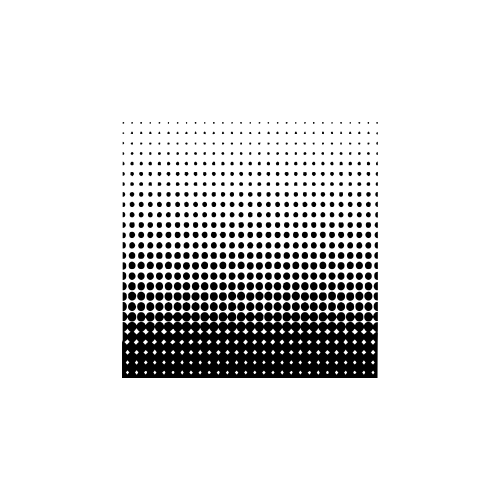 0Ombré (from French, meaning "shaded") describes any design or dyeing technique in which colour blends progressively across a surface rather than changing sharply. The transition may move from dark to light, from one hue to another, or from saturated to washed out. The key characteristic is continuity: the shift is gradual and seamless, with no visible boundary between zones. In surface pattern design, ombré applies both as a standalone design technique (the entire fabric or wallpaper is the ombré gradient) and as a compositional element within more complex patterns (ombré backgrounds behind repeat motifs, or ombré colouring applied to individual motif elements). It functions as a colour technique rather than a motif type. Sombré - a softer, more gradual version - is occasionally distinguished from the more dramatic ombré transition.
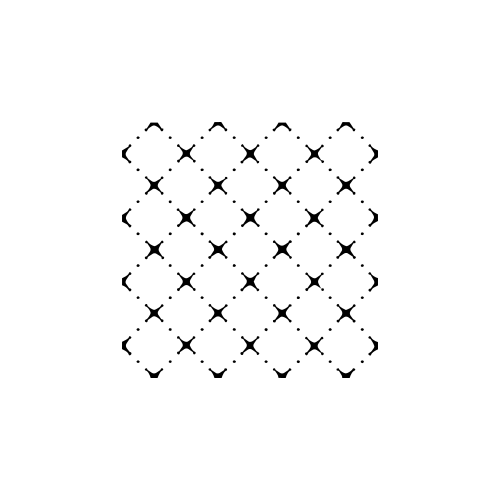 0A pattern is any regular, predictable arrangement in which elements repeat according to a consistent rule. In surface pattern design, "pattern" refers specifically to a decorative design applied to a two-dimensional surface through repeating visual elements - the primary working material of the surface pattern designer. The concept unifies highly diverse visual territory: a geometric wallpaper grid, a botanical print repeat, and a houndstooth check are all patterns in the full sense - each is governed by translational symmetry and a defined repeat unit. The word "pattern" in the decorative arts context specifically designates repeating ornamental designs manufactured for surfaces - ceramics, textiles, and wallpaper are the canonical application contexts.
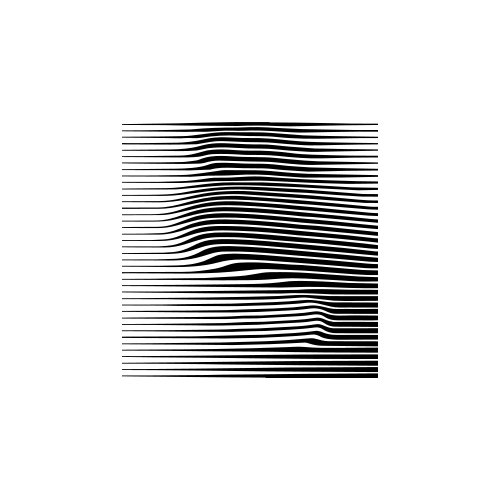 0Natural patterns are regular structures produced by physical, biological, and mathematical processes operating in living organisms and non-living physical systems. For surface pattern designers, patterns in nature are among the most important reference sources - providing the visual vocabulary of organic geometry, the colour relationships of natural pigmentation, and the structural logic of systems that repeat at multiple scales. The recognition that all natural patterns arise from a small set of underlying mechanisms - symmetry, reaction-diffusion, Fibonacci sequence, fractal iteration - gives surface designers a conceptual framework for generating and analysing naturally-inspired surface design work.
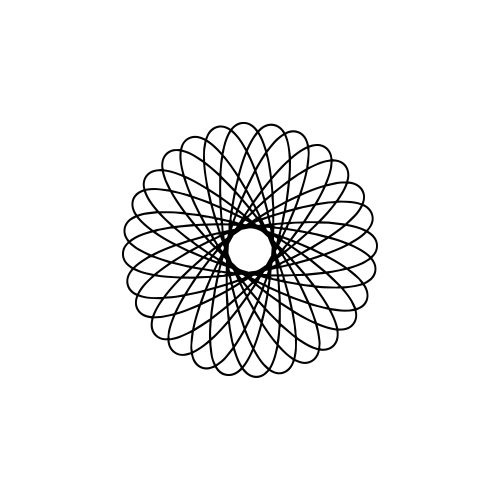 0Radial patterns organise their design elements around a central origin point, from which motifs, lines, or shapes extend outward in all directions. The structure produces a strong visual focus and an inherent sense of balance and rhythm. Radial composition is one of the most ancient and cross-cultural structural principles in decorative art, appearing in mandalas, rose windows, Islamic geometric mosaics, and natural forms.
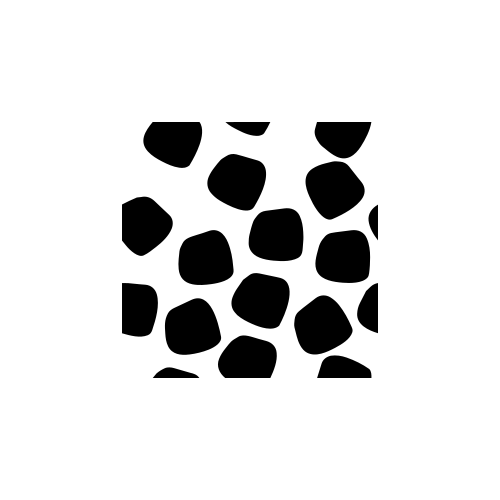 0Random patterns (or toss patterns) are one of the most technically demanding repeat structures in surface pattern design. Their purpose is to appear non-repeating: motifs are placed with varied rotation, scale, and spacing to eliminate any visible grid. When well-executed, a random pattern appears as if the motifs were scattered freely, making the tile structure invisible across a large surface. The style is particularly valued when naturalistic or loose aesthetics are the goal.
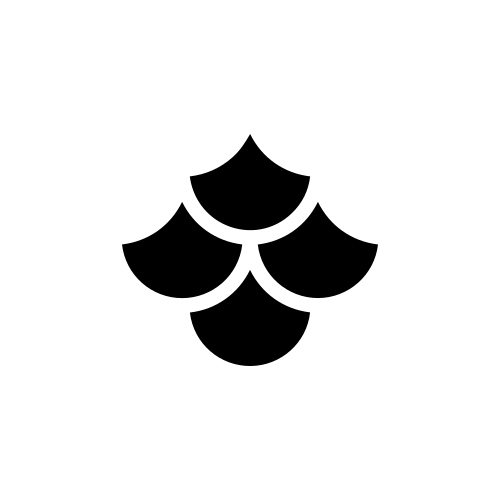 0Scale is one of the most practically significant decisions a surface pattern designer makes. The same motif at different sizes can suit entirely different markets, product categories, and production contexts. Understanding how scale reads across different product dimensions and print processes is a core technical competency in the field. Scale also affects how a pattern tiles - a very large-scale repeat may show only one partial motif on a small product, while a small-scale repeat may appear muddy at full wallpaper-panel size.
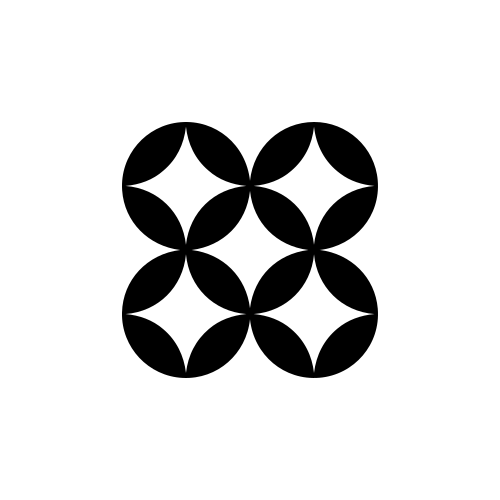 0A seamless pattern is one in which the repeat tile connects to itself at all four edges without any visible seam, break, or mismatch. This is the fundamental technical requirement for patterns applied to surfaces of arbitrary size - fabrics, wallpaper, gift wrap, and digital backgrounds must all tile seamlessly. The term describes a technical property of the pattern rather than a style or motif type. All repeating surface patterns used commercially are, by definition, seamless.
 0A simple repeating pattern is a design in which one or more motifs are systematically duplicated to create an infinitely continuous surface. The repeat unit - the smallest tile that contains the complete design - is placed according to a layout rule that governs how tiles relate to each other spatially. Understanding these layout rules is considered one of the core technical competencies of surface pattern design. Once motifs are established, a designer can produce multiple coordinating patterns by applying different repeat layouts to the same elements.
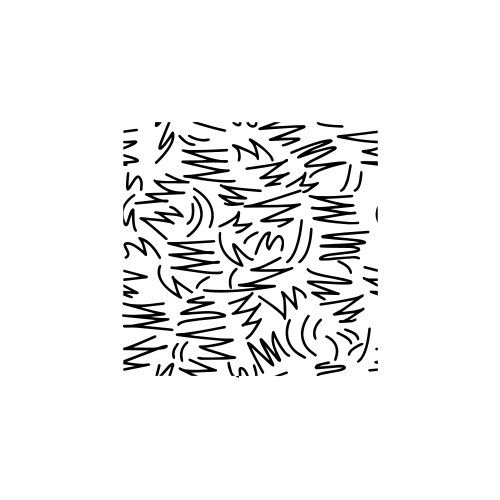 0Sketch patterns use the visual language of drawing - visible line marks, hatching, cross-hatching, shading strokes, and the characteristic looseness or precision of freehand work - as the defining aesthetic of the surface design. The sketch quality signals craft, spontaneity, and an art-directed hand-made sensibility, differentiating the design from flat vector or photographic surface treatments. Motifs may be drawn from any subject matter: botanicals, animals, geometric forms, conversational subjects, figures, or abstract mark-making. The defining characteristic is the visibility and quality of the drawn mark itself as part of the design language.
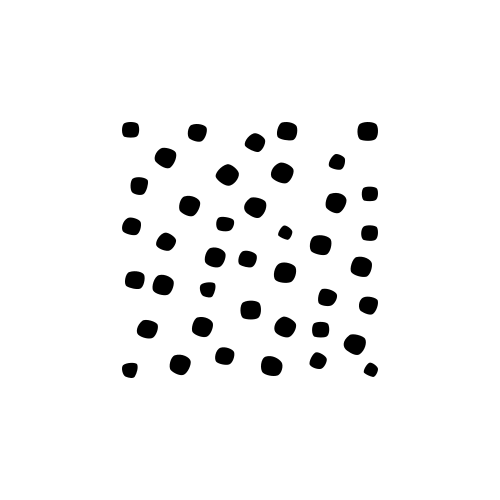 0Stippling is the use of small marks - typically dots or short flicks - to simulate graduated shading or to create an overall textural surface. In surface pattern design, stipple can be used as both a mark-making technique (producing visible dot texture within motifs) and as an all-over pattern in its own right, where densely or variably distributed dots form the design surface. The aesthetic is strongly associated with fine illustration, engraving traditions, and scientific botanical drawing, and carries associations of precision, craft, and vintage printmaking.
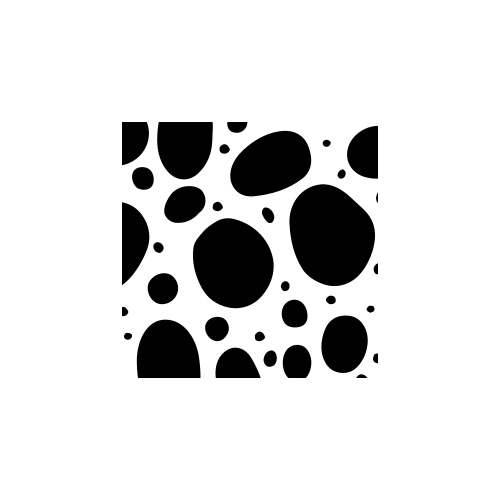 0Stone patterns occupy a dual function in surface design: they appear as decorative motifs referencing stone's aesthetic qualities (texture, grain, natural variation), and as structural patterns derived from the conventions of masonry construction (how stone blocks are cut and laid). In interior design, stone-effect surface pattern is widely used to simulate the appearance of costly or heavy stone materials on printed or laminated surfaces. In decorative pattern, stone textures are drawn on for their tactile visual weight and natural irregularity.
 0Symmetry is the mathematical and structural foundation of all repeating surface pattern. Every seamless repeat pattern uses at least translational symmetry - the ability to shift the pattern by a fixed distance and have it look identical. More complex patterns additionally use reflection (mirror), rotation, or glide reflection symmetry to create richer visual arrangements. Understanding symmetry operations is a core competency in surface pattern construction, enabling designers to build complex patterns from simple element repetitions.
 0Texture patterns occupy the boundary between surface pattern and material simulation. Their function is to add visual depth, tactile suggestion, and material character to flat surfaces. In surface pattern design, texture works both as a standalone aesthetic (small-scale all-over patterns that create a textural ground) and as an explicit simulation of specific materials - woven cloth, wood grain, stone, linen, canvas, leather, or natural fibre. The category is commercially significant in interior design, wallpaper, and substrate printing where the illusion of material quality is a purchasing driver.
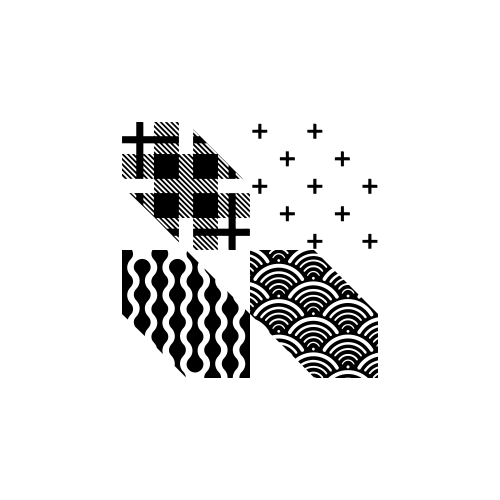 0A repeat pattern is any surface design in which a tile (or repeat unit) tessellates seamlessly across a surface. The type of repeat defines the geometric rule by which tiles relate to each other. Different repeat structures produce distinct visual rhythms and suit different markets and applications. In a pattern collection, multiple repeat types are typically used across the hero pattern and its coordinating designs to create variety and hierarchy within a unified colour and motif vocabulary.
 0Watercolour patterns translate the characteristic properties of watercolour painting - transparency, fluid colour blending, and organic mark-making - into repeating surface designs for textiles, wallpaper, stationery, and gifting. The medium's distinctive appearance (soft-edged motifs, visible water blooms, layered washes) translates well into repeat pattern construction, where the hand-painted quality adds perceived craft value and visual warmth. Designs may be painted by hand and then scanned for digitisation, or created digitally using software brushes that simulate watercolour effects. Both approaches are used commercially, though hand-painted originals carry additional authentication for premium licensing contexts.
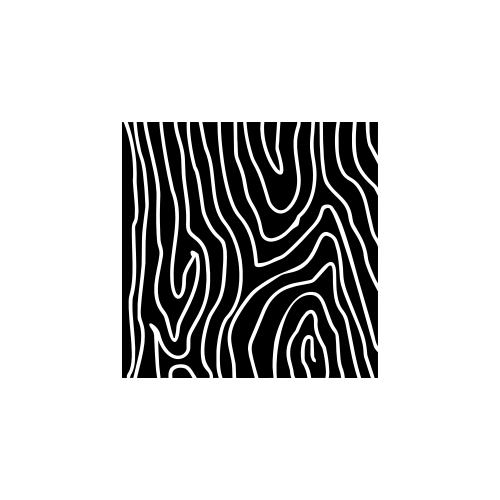 0Wood grain pattern is one of the most commercially significant natural texture categories in surface design. The visual structure of wood - parallel longitudinal fibres producing linear grain, annual growth rings producing concentric patterns in cross-section, and various figure effects (curly grain, bird's eye, tiger grain) produced by unusual growth conditions - provides a rich visual vocabulary for both decorative surface pattern and material simulation. Wood-effect printing on laminates, vinyl flooring, wallpaper, and furniture surfaces is a major commercial application driven by demand for the aesthetic quality of wood at lower cost.
You've reached the end
32 Types