Random patterns (or toss patterns) are one of the most technically demanding repeat structures in surface pattern design. Their purpose is to appear non-repeating: motifs are placed with varied rotation, scale, and spacing to eliminate any visible grid. When well-executed, a random pattern appears as if the motifs were scattered freely, making the tile structure invisible across a large surface. The style is particularly valued when naturalistic or loose aesthetics are the goal.
We use cookies to improve your experience and understand how PatternDesigners is used.
Random patterns (or toss patterns) are one of the most technically demanding repeat structures in surface pattern design. Their purpose is to appear non-repeating: motifs are placed with varied rotation, scale, and spacing to eliminate any visible grid. When well-executed, a random pattern appears as if the motifs were scattered freely, making the tile structure invisible across a large surface. The style is particularly valued when naturalistic or loose aesthetics are the goal.
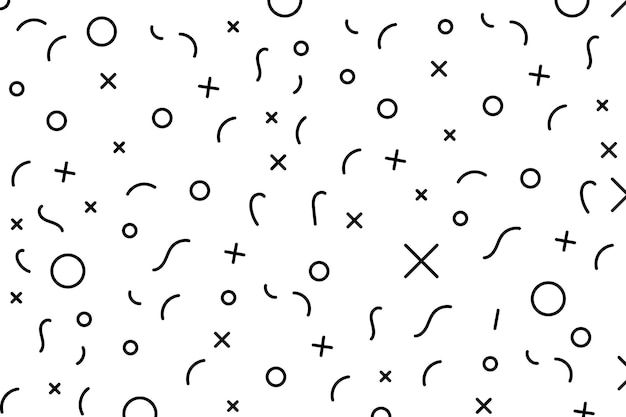
A random pattern reads as freely scattered elements with no obvious rows, columns, or diagonal alignments. Motifs appear at varied angles and may be flipped, rotated, and scaled at different values. Spacing between elements is deliberately irregular. To the viewer, the surface feels spontaneous and uncontrived. In nature, fallen leaves, scattered flowers, and forest floors are common reference points for random pattern composition.
Constructing a convincing random repeat requires deliberate technique despite the apparent lack of order. Key methods include:
The repeat tile itself is usually a square or rectangle, but the distribution within that tile is deliberately non-grid.
Random patterns are particularly associated with botanical and floral scatter prints - individual flower heads, leaves, berries, seeds, and petals distributed across the ground. Ditsy florals, confetti patterns, and abstract scatter prints all use random layout principles. The structure suits any motif that would logically appear scattered or distributed in nature.
Colour in random patterns typically supports the naturalistic intent: botanical scatter prints often use botanical palettes (greens, whites, soft florals on a light or white ground). Abstract scatter prints use bolder palettes. The structure is colour-agnostic, but high-contrast motifs on a clear ground demand more precise technical execution to avoid the eye picking up the repeat.
Scatter or toss prints have a long history in printed textile design, particularly in chintzes and floral cottons where naturalistic distribution of motifs was a design goal. The technical challenge of hiding a repeat structure in a scattered layout is one that pre-industrial hand-block printing managed through skilled placement; modern digital tools (Illustrator, Photoshop, specialised pattern software) provide more systematic approaches to the same challenge.
Random patterns (or toss patterns) are one of the most technically demanding repeat structures in surface pattern design. Their purpose is to appear non-repeating: motifs are placed with varied rotation, scale, and spacing to eliminate any visible grid.
A random pattern reads as freely scattered elements with no obvious rows, columns, or diagonal alignments. Motifs appear at varied angles and may be flipped, rotated, and scaled at different values. Spacing between elements is deliberately irregular. To the viewer, the surface feels spontaneous and uncontrived.
Fundamentals
Constructing a convincing random repeat requires deliberate technique despite the apparent lack of order.
Random patterns are particularly associated with botanical and floral scatter prints - individual flower heads, leaves, berries, seeds, and petals distributed across the ground. Ditsy florals, confetti patterns, and abstract scatter prints all use random layout principles.
Colour in random patterns typically supports the naturalistic intent: botanical scatter prints often use botanical palettes (greens, whites, soft florals on a light or white ground). Abstract scatter prints use bolder palettes.
Scatter or toss prints have a long history in printed textile design, particularly in chintzes and floral cottons where naturalistic distribution of motifs was a design goal.