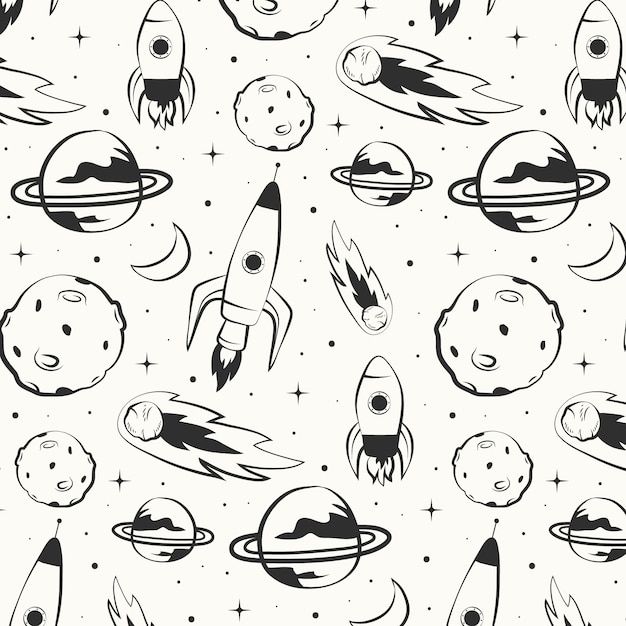
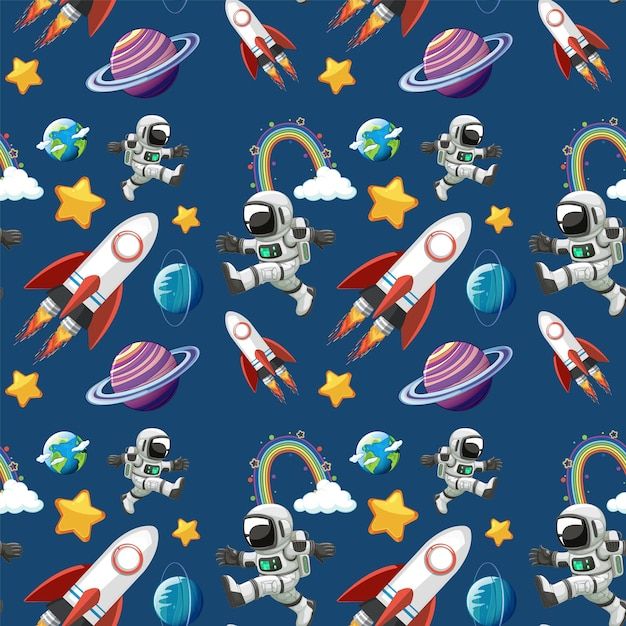
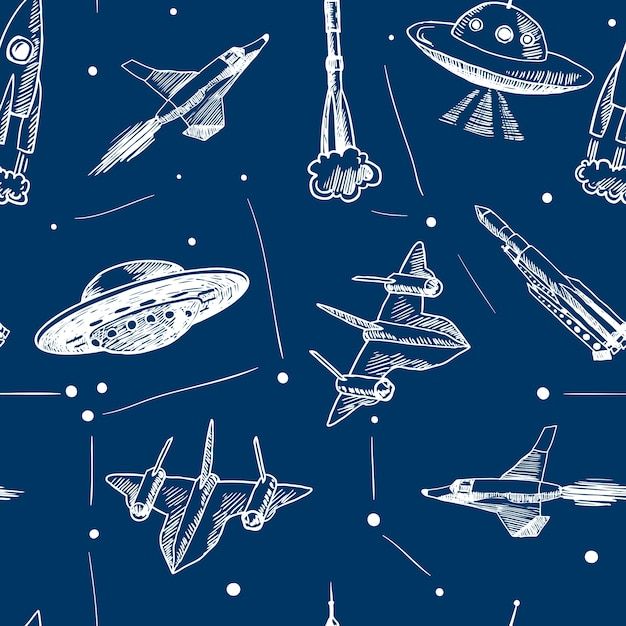
Spaceship pattern uses the recognisable silhouettes of real spacecraft - capsules, spaceplanes, rockets, satellites, and space stations - as a repeating decorative motif. The source material is a general technical reference on spacecraft engineering rather than a design or textile source, so this page is limited to the visual vocabulary of spacecraft forms that the source documents; it does not address how this vocabulary is used in surface pattern design in practice.
We use cookies to improve your experience and understand how PatternDesigners is used.
Spaceship pattern uses the recognisable silhouettes of real spacecraft - capsules, spaceplanes, rockets, satellites, and space stations - as a repeating decorative motif. The source material is a general technical reference on spacecraft engineering rather than a design or textile source, so this page is limited to the visual vocabulary of spacecraft forms that the source documents; it does not address how this vocabulary is used in surface pattern design in practice.
Spacecraft forms documented in the source fall into a few distinct silhouette families: space capsules (blunt, rounded, no wings - e.g. Vostok, Soyuz, Apollo, Orion), spaceplanes (winged, aircraft-like silhouettes - e.g. the Space Shuttle orbiter, Buran, SpaceShipTwo), rockets and boosters (tall cylindrical stacks with fins or nose cones), and satellites/space stations (modular, angular structures with extended solar panel arrays, such as the International Space Station or Hubble Space Telescope). This gives the motif category a varied but immediately legible set of shapes - rounded capsules, sleek winged forms, and angular hardware - that read clearly at small scale.
The source provides no information on repeat layout, scale, or composition conventions for this motif in surface pattern design.
Not addressed by the source. Real spacecraft liveries mentioned include a bright orange external tank (Space Shuttle) and white/silver capsule and station exteriors, but the source does not describe these as stylistic conventions for a decorative motif.
The source traces the real history of spaceflight technology (Sputnik 1 in 1957, Vostok 1 in 1961, the Space Shuttle 1981-2011, and current vehicles such as SpaceX Dragon 2 and Starship) but does not address when or how spacecraft imagery entered decorative or surface pattern design. Any claim about the motif's design history would be speculative and is omitted.
Not documented in the source. The source is a technical/historical account of spacecraft engineering and contains no material on textile, wallpaper, stationery, or other surface pattern applications.
Spaceship pattern uses the recognisable silhouettes of real spacecraft - capsules, spaceplanes, rockets, satellites, and space stations - as a repeating decorative motif.
g. g. the Space Shuttle orbiter, Buran, SpaceShipTwo), rockets and boosters (tall cylindrical stacks with fins or nose cones), and satellites/space stations (modular, angular structures with extended solar panel arrays, such as the International Space Station or Hubble Space Telescope).
Not documented in the source. The source is a technical/historical account of spacecraft engineering and contains no material on textile, wallpaper, stationery, or other surface pattern applications.
The source provides no information on repeat layout, scale, or composition conventions for this motif in surface pattern design.
Celestial and Novelty
Not addressed by the source. Real spacecraft liveries mentioned include a bright orange external tank (Space Shuttle) and white/silver capsule and station exteriors, but the source does not describe these as stylistic conventions for a decorative motif.
The source traces the real history of spaceflight technology (Sputnik 1 in 1957, Vostok 1 in 1961, the Space Shuttle 1981-2011, and current vehicles such as SpaceX Dragon 2 and Starship) but does not address when or how spacecraft imagery entered decorative or surface pattern design.
Star Pattern and Astrology Pattern