Types
 1Art Deco is one of the most commercially significant historical styles in surface pattern design. Its geometric vocabulary, metallic sensibility, and associations with glamour and modernity make it a perennial category across fashion, interiors, wallpaper, and licensing. The style emerged from a collision of geometric abstraction, exotic ornamental traditions, and a deliberate celebration of contemporary materials and industrial production. It remains among the most recognisable and commercially active historical design movements.
 0Butterfly pattern has a long history in both fine decorative arts and commercial surface design. As a motif, the butterfly offers symmetry, colour complexity, wing-surface variation, and symbolic richness - making it commercially active across luxury fashion, interior wallpaper, scarves, upholstery, and licensing. The historical trajectory of butterfly pattern runs from scientific illustration (E.A. Seguy, 1925) through haute couture (Schiaparelli, McQueen) to contemporary wallpaper and textiles. Moths are frequently treated as aesthetic extensions of butterfly pattern, with their own design vocabulary.
 0A chevron is a V-shaped mark or symbol, often shown inverted (point down). Historically the term refers to a fret in architecture, a badge or insignia denoting military or police rank, and a heraldic ordinary - one of the simple geometric figures forming the basis of many coats of arms. As a surface pattern motif, the chevron's appeal lies in this same simple, high-contrast V-shape geometry, repeated to form a zigzag.
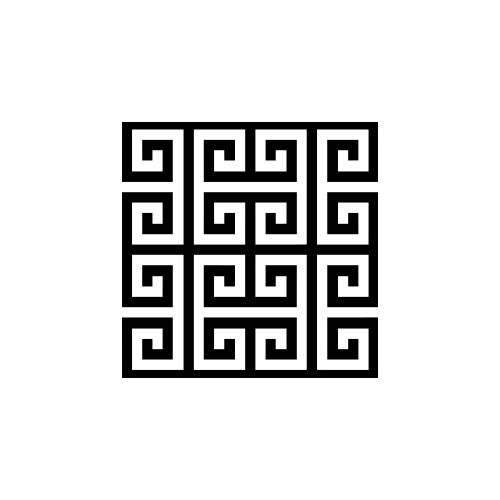 0The Greek key (or meander) is a continuous geometric border motif formed by a single line turning back on itself at right angles to create a square spiral or labyrinthine sequence. It is one of the most historically persistent ornamental motifs in the world, appearing independently in ancient Chinese bronzes, Mesoamerican design, and classical Greek pottery before becoming a defining ornamental element of Neoclassical, Beaux-Arts, and Art Deco design. In surface pattern design, the Greek key is commercially active as a border, stripe, and all-over repeat in luxury interiors, fashion accessories, and licensing.
 0In surface pattern design, "vintage" refers to patterns that authentically originate from or are designed to closely replicate the aesthetics of an earlier era, most commonly the 1920s through 1970s. The term is distinct from "retro" - which refers to contemporary designs consciously invoking past aesthetics - though the terms overlap in commercial usage. Vintage patterns carry the design conventions, print technologies, and colour palette limitations of their period of origin, giving them a distinctive quality that is difficult to precisely replicate digitally.
You've reached the end
5 Types