Companies
Alexander McQueen is a British luxury fashion brand founded in London in 1992 by Lee Alexander McQueen (17 March 1969 - 11 February 2010). In December 2000, Gucci Group (now Kering) acquired 51% of the company, funding global boutique expansion and product range extension into perfume, eyewear, accessories, trainers, and menswear. Following McQueen's death, long-time collaborator Sarah Burton became creative director in May 2010. By the end of 2020 the brand operated 100 stores worldwide, with estimated revenues of €500m.
McQueen's design language fused sharp Savile Row tailoring with historicist and natural-history themes: Scottish Highland culture, medieval and British Empire romanticism, Darwinian evolution, Arts and Crafts craft heritage, and post-human futures. Surface extremity - bleached fabric, slashed garments, robotic spray-paint, taxidermied animals as runway décor - defined brand positioning. Jeweller Shaun Leane produced collaborating pieces across multiple collections (Spine Corset, Coiled Corset, yashmak in aluminium and crystal).
Under Sarah Burton (from SS2011), the house maintained craft and embellishment heritage, including commissions of significant ceremonial importance (Royal Wedding 2011; Princess Charlotte's christening).
FashionUK0ASOS plc is a British online fashion and cosmetics retailer founded in London on 3 June 2000. Originally trading as AsSeenOnScreen (celebrity-inspired clothing imitations), the company pivoted to own-label womenswear in 2004 and grew into a multi-brand platform. ASOS ships to all 196 countries from fulfilment centres in the UK, US, and Europe, and lists over 850 brands alongside its own label. In February 2021, ASOS acquired the Topshop, Topman, Miss Selfridge, and HIIT brands from the collapsed Arcadia Group for £330M. As of March 2026, Frasers Group is the largest stakeholder at 29.26%; Bestseller A/S (owned by Anders Holch Povlsen) holds 26%.
ASOS operates as a trend aggregator and accelerator: the platform sells across price points and aesthetics, allowing the own-label team to respond rapidly to emerging print and pattern trends. The Topshop acquisition brought heritage print archives and a design identity associated with British high street fashion of the 2000s-2010s. ASOS Style Match (2017) uses computer vision to match uploaded images against shoppable products - a tool with direct relevance to pattern and print discovery. The "See My Fit" feature (2019), developed with Israeli AI company Zeekit, displays garments on different body shapes via AI simulation. Deep learning-based personalisation was implemented in early 2018.
FashionUK0AWWG (operating site: awwg.com) is the group entity managing a portfolio of three fashion brands: Pepe Jeans London, Hackett London, and Façonnable. The source material - the AWWG brand portfolio page - describes the identity and positioning of each brand within the group but provides no corporate background on AWWG itself: no founding date, ownership structure, revenue, or employee count is documented. The three brands span denim-led international fashion (Pepe Jeans), British heritage menswear with Savile Row credentials (Hackett), and French Riviera smart-casual menswear (Façonnable).
No named creative director documented for AWWG or any of the three brands. Pepe Jeans' direction is explicitly anchored in its Portobello Road DNA and denim-led positioning. Hackett's direction integrates British heritage with contemporary menswear; the Savile Row bespoke service represents the brand's highest-design-quality offering, dependent on premium mill fabric selection. Façonnable's creative direction is rooted in the lifestyle of the Côte d'Azur with a consistent nautical and Mediterranean identity.
FashionUK0J. Barbour & Sons, Limited (trading as Barbour) is an English luxury and lifestyle brand founded in South Shields, England, in 1894 by John Barbour, originally as an importer of oilcloth. The brand is best known for its waxed cotton outerwear - particularly the Beaufort Jacket (introduced 1983), with its waxed olive exterior, brown corduroy collar, and tartan lining. Barbour holds royal warrants for the supply of waterproof and protective clothing from the Duke of Edinburgh (1974), Queen Elizabeth II (1982), and King Charles III (1987). The company remains family-owned and is led by Dame Margaret Barbour (chair since 1973, fourth generation), with Helen Barbour (vice chair since 1997) representing the fifth generation.
Barbour's design is anchored in British country heritage: waxed or quilted outerwear, traditional textiles (moleskin, corduroy, tattersall), and practical functional details (storm cuffs, game pockets, waterproof drainage pockets). The Beaufort Jacket's design is described as French in origin, tailored to British needs. In recent years the company has modernised collections for younger and urban audiences while maintaining credibility with the traditional countryside customer - drawing on the Barbour International motorcycle heritage as a bridge between the two markets.
FashionUK0Basso & Brooke is a London-based fashion label founded by Bruno Basso (born Santos, São Paulo, Brazil) and Christopher Brooke (born Newark-on-Trent, UK). The two met in 2001 and produced their first collection in 2004. They were the inaugural winners of Fashion Fringe, the UK talent competition searching for emerging fashion talent. The label is internationally recognised as a pioneer of digital print technique in the fashion industry. Tim Blanks of Style.com described them as "the Pixar of clothes"; press described them as "the masters of fantastical digital print." Basso & Brooke operates within the Aeffe portfolio.
Note: YAML location field shows "United States" - Basso & Brooke is a London-based label. This appears to be a placeholder data error. YAML preserved as found.
The label's aesthetic vocabulary is defined by fantastical, large-scale digital print - maximalist in colour, surreal in motif, photographic in resolution. Their work consistently applied print to the full garment surface, using the entire piece as a print canvas. Fashion press consistently categorised them at the boundary of fashion and digital art.
FashionUK0Burberry Group plc is a British luxury fashion house founded in 1856 by Thomas Burberry in Basingstoke, Hampshire, and headquartered in London. The company is listed on the London Stock Exchange and is a constituent of the FTSE 100 Index. Burberry is best known for the trench coat - developed from British military outerwear during the First World War - and for the Burberry Check, a camel, black, red, and white check pattern that became one of the most recognised branded surface patterns in the world. Gabardine fabric, invented by Thomas Burberry in 1879 (yarn waterproofed before weaving), underpins the brand's material heritage. After a period of brand overexposure and counterfeit proliferation (2001-2005), a deliberate luxury repositioning under CEO Angela Ahrendts and Creative Director Christopher Bailey reduced the check to 10% of products. As of FY2026, Burberry operates 410 stores globally; a cost-cutting programme and workforce reduction of up to 1,700 are ongoing under CEO Joshua Schulman (appointed July 2024).
Burberry's design has cycled through three distinct creative eras since 2001. Christopher Bailey (2001-2018) modernised the brand's British heritage references and established its digital leadership. Riccardo Tisci (2018-2022) introduced a darker, streetwear-adjacent aesthetic with the TB Monogram and Peter Saville-designed rebrand (2018). Daniel Lee (from September 2022), formerly of Bottega Veneta, revived the Equestrian Knight logo (February 2023) and repositioned the brand toward "a modern take on British luxury" - using distinctly British cultural figures (Shygirl, Skepta, Kano) as campaign faces. The current Schulman-era turnaround (from November 2024) refocuses commercial priorities on outerwear and core accessories, including a "scarf bar" retail format.
FashionUK0Chanel is a French luxury fashion house founded in 1910 by Gabrielle "Coco" Chanel, initially as a millinery shop in Paris. It is privately owned by French brothers Alain and Gérard Wertheimer through the holding company Chanel Limited, established in 2018 and headquartered in London. The house specialises in women's ready-to-wear, luxury goods, and accessories, and licences its brand name to Luxottica for eyewear. Karl Lagerfeld served as chief designer from 1983 until his death in February 2019; Virginie Viard succeeded him and served until June 2024; Matthieu Blazy (formerly creative director of Bottega Veneta) was appointed artistic director in December 2024. Leena Nair has served as Global CEO since December 2021. Worldwide, Chanel S.A. operates approximately 310 boutiques. Parfums Chanel - the fragrance and cosmetics division - is historically its most profitable business unit.
Coco Chanel's foundational design philosophy - simplicity, functionality, and the repurposing of masculine fabrics and forms for women - established an aesthetic vocabulary that Karl Lagerfeld maintained and evolved for 35 years (1983-2019). Lagerfeld retained tweed, gold chains, quilted leather, and the double-C monogram as signature design constants while reinventing seasonal references. Virginie Viard (2019-2024) continued in this register. Matthieu Blazy's appointment in December 2024 - his debut space-themed runway show in Paris (October 2025) was credited as a new direction - signals a potential shift away from Lagerfeld-era vocabulary. Design is anchored by the Paraffection ateliers, which supply embroidery, feathers, and ornamentation directly into couture collections.
FashionUK0Charlotte Tilbury Beauty Ltd is a British luxury beauty brand founded in October 2013 by makeup artist and entrepreneur Charlotte Emma Bow Tilbury MBE (born 10 February 1973, Kensington). The brand launched at Selfridges, London, with a lineup of skincare and makeup products. Tilbury's signature product, Magic Cream, was formulated backstage during years of fashion show work (as show makeup director for Prada, McQueen, Cavalli, Lanvin, and Chloé). In June 2020, Spanish conglomerate Puig acquired a majority stake; Tilbury retained a significant minority stake and continues as chair, president, and chief creative officer, also serving on Puig's executive committee. Tilbury's net worth was estimated at £350 million as of March 2025.
Note: YAML location field shows "Spain" - Charlotte Tilbury Beauty Ltd is a British brand, founded and headquartered in London; Puig (Spain) holds the majority stake. This appears to reflect the parent company's geography. YAML preserved as found.
The brand's aesthetic is unapologetically glamorous: champagne gold, Hollywood references, a "Magic" brand vocabulary, and a surface identity that reads luxury across both the product line and retail environment. Creative direction is Tilbury's own; she is founder, chair, president, and chief creative officer. The "makeup wardrobe" concept applies editorial fashion logic - curated looks, complementary product groupings - to beauty product surface presentation.
FashionUK0Dr. Martens - also known as Doc Martens, Docs, or DMs - is a British footwear and clothing brand headquartered at Camden Town, London. The brand is most recognised for its air-cushioned sole, distinctive upper silhouette, welted construction, and yellow stitching. Manufacturing operates across the UK (Cobbs Lane factory, Wollaston, Northamptonshire, the brand's historic production site) and China, Vietnam, Laos, and Thailand. Dr. Martens is listed on the London Stock Exchange and is a constituent of the FTSE 250 Index. In January 2021, the company made its LSE debut at a valuation of £3.7 billion.
The brand's design language is defined by the 1460 silhouette and its material vocabulary: leather upper, air-cushioned PVC sole, yellow stitching, Goodyear welt construction. Beyond the core product, the design trajectory has moved through working-class utility (1960s), punk and subculture appropriation (1970s-1980s), mainstream fashion crossover and overextension (1990s), near-commercial collapse (early 2000s, UK factory closures), vintage-driven revival (2010s), and commercial scaling post-IPO (2021-present). The Camden Town HQ and design studio signals investment in British street culture as an ongoing creative reference point.
FashionUK0Global Fashion Group S.A. (GFG) is a Luxembourg-registered, London-headquartered online fashion and lifestyle platform group. Established in 2014 through the consolidation of regional fashion e-commerce companies backed by Kinnevik and Rocket Internet, GFG operates across nine markets with a combined population of over 700 million people and a fashion market estimated at over €350 billion. Its three operating platforms are THE ICONIC (Australia and New Zealand), Dafiti (Latin America), and ZALORA (Southeast Asia). As of end 2018, the group had more than 11 million active customers and over 10,000 employees. GFG is listed on the Frankfurt Stock Exchange (ticker: GFG). Christoph Barchewitz is CEO.
GFG's private label design teams work with in-house designers and local designers in each region. No named group-level creative director is documented. Design strategy is market-specific: ZALORA's Zalia label follows modest fashion aesthetics relevant to Southeast Asian consumer preferences; Lost Ink addresses mainstream trend fashion. The marketplace model allows GFG to curate international brands without bearing design responsibility, while private labels fill gaps in the assortment with own-brand design.
FashionUK0Gymshark Ltd is a British multinational athletic apparel retailer headquartered at Blythe Valley Park, Solihull, West Midlands. Founded in June 2012 by Ben Francis and Lewis Morgan, both aged 20, the company began in Francis's parents' garage using a £1,000 sewing machine and screen printer. It grew into a DTC global brand with 10 million customers, 18 million social media followers, and operations in 230+ countries. General Atlantic acquired a 21% stake for £275 million in August 2020, valuing the company at over £1 billion. A proposed business restructure in April 2025 placed approximately 300 jobs at risk despite the company reporting record sales.
Minimalist performance aesthetic. Surface design is primarily expressed through brand logo graphic, colourway, and garment silhouette rather than complex print or pattern. The brand's visual identity is closely tied to its digital-first, community-driven positioning. The appointment of a bodybuilder (David Laid) as creative director of lifting signals that design direction is informed by athletic subculture and influencer identity rather than traditional fashion design hierarchy.
FashionUK0Hackett London was founded in 1983 by Jeremy Hackett and Ashley Lloyd-Jennings, who began by sourcing and selling vintage British menswear from a Portobello Road stall. The first Hackett shop opened at the "wrong end" of the King's Road, Chelsea, initially trading in vintage pieces before transitioning to original design. The brand developed around classic British menswear codes: tailoring, polo shirts, blazers, and accessories rooted in the English country and sporting tradition. International expansion followed - Spain (1989), Paris (1994), a children's line (1995). Michael Sondag, formerly of Tommy Hilfiger, joined as creative director in 2005 following Richemont's sale of the brand to Torreal S.C.R. In February 2015, Pepe Jeans Group - owned by M1 Group (Lebanon) and L Capital Asia (an LVMH subsidiary) - acquired Hackett. By 2019, the brand operated approximately 160 stores globally. YAML location "United Kingdom" is correct.
Rooted in English heritage and Savile Row tradition, with controlled seasonal adjustment. Creative director Michael Sondag's Tommy Hilfiger background introduced preparatory-school Americana alongside British codes. The brand's visual surface language is conservative and craft-oriented - focused on fabric quality, weave structure, and established textile motifs rather than trend-driven print direction.
FashionUK0IC Group A/S (originally IC Companys) is a Copenhagen-based Scandinavian fashion group formed in 2001 through the merger of InWear Group A/S and Carli Gry International A/S. The company was publicly listed on the Copenhagen Stock Exchange before being taken private in May 2019, when main shareholder Friheden Invest A/S made an offer for the outstanding shares. Following a major brand disposal programme between 2013 and 2019, the group now operates three brands: By Malene Birger (luxury women's fashion), Designers Remix (contemporary women's fashion), and Tiger of Sweden (Scandinavian heritage tailoring and contemporary fashion). The company was renamed IC Group (from IC Companys) after the 2014 brand disposal round.
By Malene Birger was co-founded with and associated with designer Malene Birger herself (joint venture from 2003). Designers Remix was founded by Charlotte Eskildsen. No group-level creative director is documented in the available source. Design authority sits within each brand team.
FashionUK0JD Sports Fashion plc (commonly JD Sports, JD, or JD Group) is a British multinational sports-fashion retail company headquartered in Bury, Greater Manchester, England. Founded in 1981 by John Wardle and David Makin (the initials forming the "JD" name), the company began as a single shop and has grown into one of the world's largest sports-fashion retail groups through aggressive acquisition. JD Sports is listed on the London Stock Exchange and is a constituent of the FTSE 100 Index. The Pentland Group holds a 55% ownership stake. The group operates primarily across Europe, North America, and Asia-Pacific. Notable recent acquisitions include Finish Line (USA, ~$558M, 2018), Shoe Palace ($325M, 2020), DTLR ($360M, 2021), Courir and Gap France (September 2023), and Hibbett ($1.08B, 2024).
JD Sports is a retailer and brand aggregator rather than a design-originating entity. Its own-label product (if any) is not detailed in the source. Design authority sits with the branded manufacturers (Nike, Adidas, etc.) whose products dominate the assortment. Canterbury and Canterbury of New Zealand maintain their own heritage-brand design identity for rugby. The group's curation of premium sneaker and streetwear-adjacent product lines represents an editorial design decision rather than in-house creative production.
FashionUK0Jimmy Choo was founded in May 1996 when Tamara Mellon (Vogue accessories editor) partnered with Jimmy Choo - a Malaysian-born couture shoemaker who had operated a workshop in a converted Metropolitan Free Hospital building in Hackney, East End London since the late 1980s. The Yeardye family (Tom and Ann) invested £150,000 for 50% of J. Choo Limited. Jimmy Choo's couture work included custom commissions for Princess Diana (from 1991) and high-profile colour customisation for Oscar nights, including dyeing shoes to match actresses' gowns for the 1999 Academy Awards. Sandra Choi, Choo's wife's niece, joined in 1989 and rapidly took charge of the design studio. Jimmy Choo himself sold his 50% stake for £8.8 million in November 2001 and departed; the brand continued scaling under successive private equity owners. The brand was name-dropped in Sex and the City Season 1 Episode 5 (July 5, 1998) - "I lost my Choo!" - establishing celebrity-driven marketing that was central to its early US expansion. The first US stores opened November 1998. Ownership: Phoenix Equity (£18M, November 2001) → Lion Capital (£101M, November 2004) → TowerBrook Capital/Gala Capital (£185M, February 2007) → Labelux/JAB Holding (£525.5M, 2011) → London Stock Exchange IPO (140p, £546M equity, October 2014) → Michael Kors Holdings ($1.2B/£896M, completed November 1, 2017; company renamed Capri Holdings). Pierre Denis (ex-LVMH) joined as CEO in 2012. Sandra Choi appointed sole Creative Director in 2013. Hannah Colman - the brand's first saleswoman (1996) - named CEO late 2020. Brand ambassadors: Cho Mi-yeon of (G)I-dle (August 2023, global); Wang Yibo (September 2024, global). YAML parent_company "capri-holdings" is correct. YAML location "United States" is incorrect - British luxury fashion house, founded and headquartered in London; YAML preserved as found.
Sandra Choi has been Creative Director since 1989 in practice (sole title since 2013) - one of the longest-serving creative directors in luxury fashion. Her design vocabulary centres on the tension between glamour and wearability: sculptural heel forms, precious surface materials, and bold embellishment alongside more restrained, everyday-accessible styles. The brand has expanded from couture-adjacent women's footwear into a full lifestyle accessories and fragrance proposition without abandoning the glamour positioning that the founding studio established.
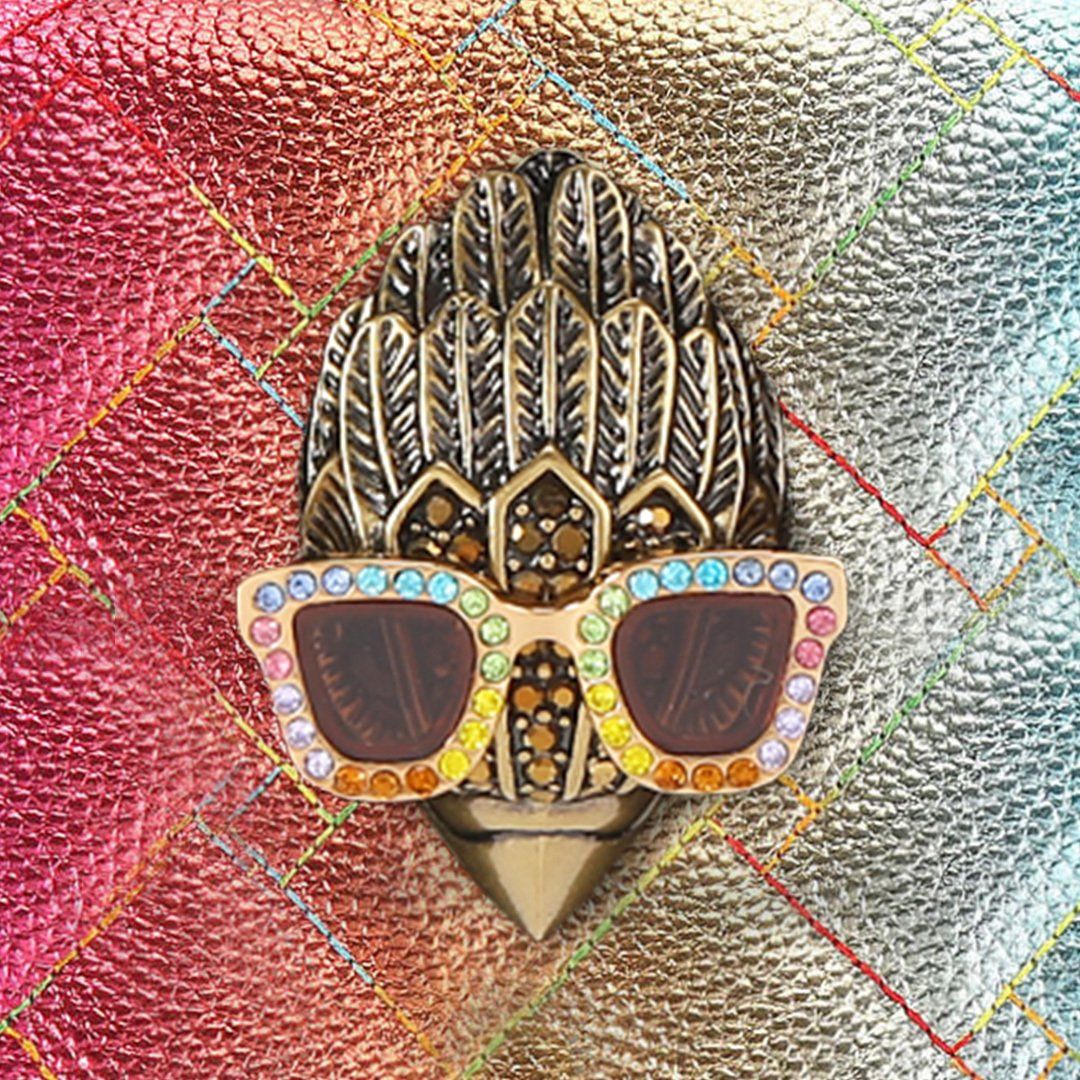
FashionUK0Kurt Geiger is a luxury British footwear and accessories brand, named after its Austrian founder and fashion designer. The company operates approximately 70 standalone stores and concession departments within major UK luxury department stores including Harrods and Selfridges. It owns three brands developed by its in-house team: Kurt Geiger London, KG Kurt Geiger, and Carvela. Headquartered at Britton Street, Clerkenwell, London, in a building remodelled in 2009 by Archer Architects, finished in a distinctive Pompeian Red exterior.
Three in-house brands, each developed by the Kurt Geiger design team. No external design direction or named creative director is documented in the source material. The Clerkenwell headquarters, rebuilt in a distinctive Pompeian Red finish (Archer Architects, 2009), suggests an awareness of design identity extending to the brand's physical environment. The company's luxury department store concession strategy implies seasonal design renewal as a commercial requirement.
FashionUK0Manolo Blahnik (Manuel Blahnik Rodríguez, born 27 November 1942) is a Spanish fashion designer and the founder of the Manolo Blahnik brand. Born in Santa Cruz de la Palma, Canary Islands, to a Czech father and Spanish mother, Blahnik studied literature and architecture at the University of Geneva, then art at the École des Beaux-Arts in Paris and Stage Set Design at the Louvre Art School. After relocating to London in 1969 to work as a buyer at the fashion boutique Feathers, he met U.S. Vogue editor-in-chief Diana Vreeland in New York, who advised him to focus on shoe design. Blahnik purchased the Zapata Shoe Company with a £2,000 loan in 1971 and opened his own boutique. The flagship store remains on Old Church Street, Chelsea. Blahnik resides in Bath, England.
Driven by the designer personally; no art director or creative team is named in the source material. Design inspiration: architecture, art, film, and a personal aesthetic formed by formative exposure to European couture textiles and antique luxury fabrics. Signature: the stiletto heel and refined, feminine silhouette. Fabric-forward material selection (brocade, satin, silk, lace) is the primary surface design variable. Blahnik has stated his dislike of wedge heels, affirming a consistent and narrow design point of view maintained across his career.
FashionUK0Marks and Spencer plc (M&S) is a major British multinational retailer headquartered in London. Founded in 1884 as a penny bazaar on Kirkgate Market in Leeds by Michael Marks (Polish-Jewish immigrant from Slonim, Belarus) and Thomas Spencer (cashier from Skipton, North Yorkshire), M&S grew from market stalls into one of the UK's largest retailers. The company built its reputation on a policy of selling 99% British-made goods, maintained until the 1990s, supported by long-term relationships with British manufacturers. Textiles were first sold in 1926; food followed in 1931. M&S became the first British retailer to make a pre-tax profit of more than £1 billion in 1998. Turnover for the 52 weeks ended 29 March 2025 was £13.8 billion. The company targets a UK estate of 180 full-line and 420 food stores. An April 2025 ransomware cyber attack (attributed to Scattered Spider) caused estimated losses of up to £300 million; online ordering was restored June 2025.
Own-brand clothing design across multiple sub-brands (Per Una, Autograph, Indigo, Best of British, Limited Edition). No single named creative director for clothing is documented; the Per Una range had George Davies as its original designer-director (2001-2004). The 2002 introduction of Per Una is documented as the primary mechanism by which M&S attempted to reintroduce distinct fashion design into its clothing range after womenswear sales hit a 10-year low in 2010. Current CEO Stuart Machin has led a recovery strategy that includes fabric quality and clothing design investment alongside food transformation.
FashionUK0Monsoon Accessorize is a British private limited company that operates two international fashion retail chains: Monsoon and Accessorize. Monsoon was founded in London in 1973 by Peter Simon, who started as a market-stall trader and opened the first Monsoon shop at Beauchamp Place, Knightsbridge, in May 1973. The first Accessorize shop opened in 1984, adjacent to Monsoon in Covent Garden. The company has operated as a private business for most of its history - listed on the London Stock Exchange from 1998 until Peter Simon took it private again in 2007 for £185 million. In June 2020 the company went into administration during the COVID-19 pandemic and was immediately bought by its founder, with 35 UK store closures and 545 job losses. Peter Simon bought it out of a second administration in late 2022. In 2018 the UK estate comprised 181 stores and turnover was £296 million.
No named creative director is documented in the source. Monsoon's aesthetic identity - global print influences, surface embellishment, artisanal textile references - has been commercially consistent since the brand's 1973 founding, operating as a house aesthetic rather than a designer-led direction. The company's art collection (~300 works of modern and contemporary art, housed at the Notting Dale HQ) reflects Peter Simon's personal cultural engagement, which has been noted in profiles as informing his approach to the brand's aesthetic.
FashionUK0New Look is a British fashion retailer selling womenswear, menswear, and clothing for teens through a chain of high street shops. Founded in 1969 by Tom Singh in Taunton, Somerset, the company expanded from a single UK store into a chain that at its peak operated over 900 shops internationally. International presence at various points included Ireland (from 2003), Belgium (2006), France, Netherlands, Romania, Malaysia, South Korea, Singapore, Thailand, Indonesia, UAE, China, Germany, Russia, Bahrain, Saudi Arabia, Azerbaijan, and Poland; the company employed over 18,000 staff and recorded a turnover of £1,147 million with profits of £180 million in 2008. In 2015, New Look was acquired by South African investment company Brait SE for £780 million; at the time it operated 852 stores globally, including 94 in China. A restructuring in 2018 closed 60 UK shops and withdrew from most international markets. In 2020, COVID-19 prompted a Chapter 15 bankruptcy filing in the US. By February 2025, the company exited the Irish market after the High Court of Ireland appointed provisional liquidators to its Irish operations.
No named creative director or design team documented in the source. The company's design direction was market-responsive and price-sensitive - womenswear at accessible price points with a value-fashion positioning. The China localisation strategy suggests design input was adapted by market. "My Life My Style My Look" (2017) represents the brand's clearest documented attempt to build a design-as-identity narrative.
FashionUK0Next plc is a British multinational clothing, footwear, and home products retailer headquartered in Enderby, England. The company operates approximately 700 stores - around 500 in the UK and 200 internationally across Europe, Asia, and the Middle East - and is listed on the London Stock Exchange as a FTSE 100 constituent. As of FY January 2026, Next reported revenue of £6.9 billion and net income of £898 million. Next became the largest UK clothing retailer by sales in 2012, overtaking Marks & Spencer, a position it confirmed again in 2014.
The company traces its origins to a Leeds tailor founded in 1864 by Joseph Hepworth. The Next brand was created in 1982 by designer-retailer George Davies (recruited by Terence Conran, then Chairman of Hepworth) to replace the Kendall's womenswear chain acquired in 1981. The brand formula - coordinated clothing ranges in an edited, designed environment - was expanded into menswear in 1984 and home furnishings shortly after. The Next Directory home shopping catalogue launched in 1988.
George Davies created the Next brand aesthetic in 1982 - coordinated clothing ranges in a minimal, modern retail environment, targeting womenswear at accessible mid-market prices. Davies's formula proved transformative for British fashion retail; he was later the founder of Per Una for M&S. No single named creative director has defined Next's design identity post-Davies. The company's current direction is commercially driven by sales performance and range planning. The acquisition of Cath Kidston, Joules, and Made.com signals an active strategy of acquiring fashion and home design brands with documented aesthetic identities rather than developing them internally.
FashionUK0Orlebar Brown was conceived by photographer Adam Brown during a holiday in India in summer 2006 and developed with co-founder Julia Simpson-Orlebar (who left the business amicably in 2008, retaining a shareholder stake). The brand launched online in March 2007, available in 105 countries. Paul Donoghue was appointed global commercial director in 2013 following a £8 million private-equity investment from Piper. Revenue reached £12M in 2014 (from £7M in 2013), with £20M projected for 2016. Chanel acquired the company in September 2018; Adam Brown retained the creative director role. The company is based in West London and employs over 50 people. YAML parent_company "chanel" is correct (Chanel acquired September 2018). YAML location "United States" is incorrect - Orlebar Brown is a British brand, West London HQ; YAML preserved as found. YAML market_categories "Running" is incorrect for a brand focused on swimwear and resort menswear; YAML preserved as found.
Adam Brown's background as a photographer informs Orlebar Brown's visual approach - strong colorway, image-conscious styling, and print direction on the swim short as seasonal creative canvas. The construction logic (suit-trouser pattern applied to swimwear) is a structural proposition; the surface - print, colorway, trim - is the season-to-season design output. Chanel's acquisition (September 2018) positions the brand alongside Chanel's broader luxury accessories portfolio.
FashionUK0Paul Smith is the eponymous brand of Sir Paul Brierley Smith (born 1946, Beeston, Nottinghamshire), knighted in 2000 and appointed to the Order of the Companions of Honour in 2020, both for services to fashion. The brand operates 130 stores in more than 60 countries, including major presence in Japan, the US, and across Europe. Japanese trading company Itochu acquired a 40% stake in 2006; Smith retains majority control. The brand is defined by the multicoloured stripe - applied across tailoring, shirts, accessories, footwear, vehicles, sporting equipment, and technology products - making it one of the most pattern-explicit luxury brands in British fashion.
Smith's stated philosophy is "classic with a twist" - established garment forms (tailored suits, shirts, jackets) combined with unexpected colour, print, or fabrication. His background includes tailoring training and work as a buyer for Browns London; his wife Pauline trained as a fashion designer at the Royal College of Art and contributed to early collections. Cycling, graphic art, and popular culture are documented personal influences. The stripe is the recurring motif across all scales and product categories; pinstripes and windowpane checks appear regularly in tailoring.
FashionUK0Pentland Group Limited is a British privately held multinational company that owns and invests in sports, outdoor, and sports fashion businesses. Founded in 1932 when Lithuanian immigrant couple Berko and Minnie Rubin established the Liverpool Shoe Company, the business was transformed by their son Stephen Rubin - who joined as joint managing director in 1959 and became chairman on his father's death in 1969. Pentland's trajectory was defined by its 1981 acquisition of 55% of Reebok for $77,500; by 1984, Reebok accounted for 70% of Pentland's turnover, and the 1985 partial Reebok flotation valued the business at $300 million. The family took the company 100% private again in 1999. Annual sales reached $6.4 billion; the group employs more than 50,000 people. Stephen Rubin was named Britain's top taxpayer by the Sunday Times in January 2019, with a tax liability of £181.6M.
Pentland Group operates as a holding company; individual brand design teams are led at brand level. No group-level creative direction is documented in the source. The most commercially significant design identity within the owned-brand portfolio is Speedo's swim performance aesthetic and Ellesse's Italian sportswear heritage graphic. Canterbury's design is centred on licensed national team kit development.
FashionUK0