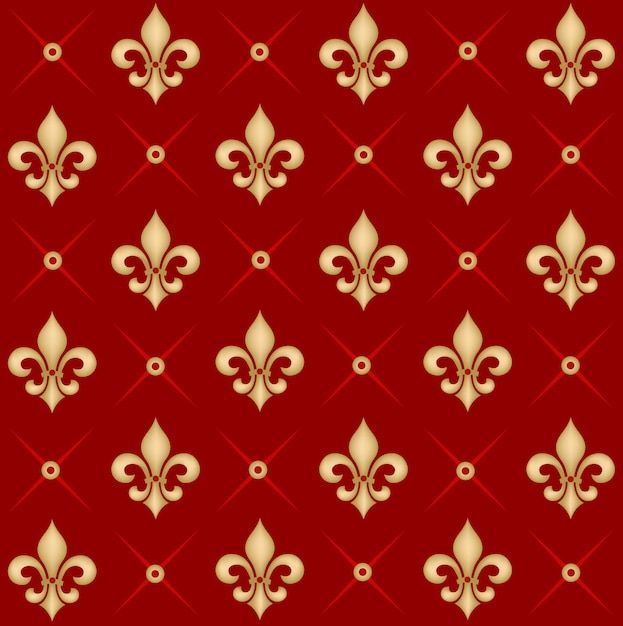
The fleur-de-lis is a symmetrical three-part form: a central upward-pointing petal flanked by two outward-curving petals, all bound at the base by a horizontal band or ring. As a surface pattern, it appears in seamless all-over repeats, formal damask compositions, trellis grids, and contemporary minimalist interpretations. Its heritage associations - French royalty, European heraldry, Christian iconography - give it a luxury and classical positioning that remains commercially active across wallpaper, home furnishings, and fashion.
We use cookies to improve your experience and understand how PatternDesigners is used.
The fleur-de-lis is a symmetrical three-part form: a central upward-pointing petal flanked by two outward-curving petals, all bound at the base by a horizontal band or ring. As a surface pattern, it appears in seamless all-over repeats, formal damask compositions, trellis grids, and contemporary minimalist interpretations. Its heritage associations - French royalty, European heraldry, Christian iconography - give it a luxury and classical positioning that remains commercially active across wallpaper, home furnishings, and fashion.
The traditional form features crisp, symmetrical curves with ornate detail at the central petal and curved flanking petals that sweep outward before terminating. The horizontal binding band or ring at the base is a defining structural element. Ornate historical versions include scrollwork, shading, and decorative interior detail. Contemporary minimalist versions reduce the form to a clean silhouette - simplified to geometric lines while remaining unmistakably recognisable.
The motif reads equally well at large scale (as a feature wallpaper or upholstery motif) and small scale (as a trellis anchor or scattered repeat element).
Four dominant layout approaches:
Classic heraldic: gold (or) on blue (azure) - the traditional French royal arms palette. Also gold or ivory on deep navy, burgundy, or green grounds.
Contemporary applications: monochrome (black on white, white on black), tonal, and metallic. Heritage and luxury positioning across all palette interpretations. The motif carries French-inflected classicism regardless of colourway.
The fleur-de-lis was the principal charge of the Royal Arms of France from the High Middle Ages through to the French Revolution in 1792, and during brief periods of the 19th century. Michel Pastoureau, the leading heraldist on the symbol, describes it as having become "at one and the same time, religious, political, dynastic, artistic, emblematic, and symbolic" - a statement of the motif's layered cultural weight.
Its botanical origin is contested. The name translates literally as "flower of the lily" (French: fleur + lis), but art historians and botanists largely agree the form more closely resembles the yellow flag iris (Iris pseudacorus) than the white lily. An 18th-century French naturalist, Pierre-Augustin Boissier de Sauvages, proposed the symbol derived from the iris growing along the river Lys in Flanders - the region where the Frankish kings lived before entering Gaul.
Ancient precursors exist across cultures: similar forms appear on Gaulish coins, in Maya art (where the water lily represented the earth's regenerative power), and on a Scythian gold helmet in the Hermitage Museum, Saint Petersburg.
Beyond France, the fleur-de-lis appears on the coat of arms and flags of Quebec, Canada, Spain (via Bourbon dynasty claims), Bosnia, and the city of Florence. New Orleans adopted it as a symbol of civic identity after Hurricane Katrina (2005). The World Scout Movement uses a modified fleur-de-lis as its symbol, adapted from the compass North mark, representing direction and service.
The fleur-de-lis is a symmetrical three-part form: a central upward-pointing petal flanked by two outward-curving petals, all bound at the base by a horizontal band or ring.
The traditional form features crisp, symmetrical curves with ornate detail at the central petal and curved flanking petals that sweep outward before terminating. The horizontal binding band or ring at the base is a defining structural element.
Wallpaper (core heritage/French/classical design language; consistent commercial demand) Upholstery and furnishing fabrics Fashion textiles: printed scarves, accessories, apparel Interior architecture: wall stencilling, carved furniture Stationery and gift packaging (prestige register)
Four dominant layout approaches: Semé: an all-over scattered repeat where individual fleur-de-lis motifs are distributed across the ground unjoined - mimicking a "field of flowers". The historical Royal Arms of France used gold fleur-de-lis on an azure/blue field in semé arrangement.
Fleur-de-lis in traditional ornate form Simplified/geometric silhouette Fleur-de-lis with damask scrollwork or vine surround Fleur-de-lis as trellis anchor
Classic heraldic: gold (or) on blue (azure) - the traditional French royal arms palette. Also gold or ivory on deep navy, burgundy, or green grounds. Contemporary applications: monochrome (black on white, white on black), tonal, and metallic. Heritage and luxury positioning across all palette interpretations.
The fleur-de-lis was the principal charge of the Royal Arms of France from the High Middle Ages through to the French Revolution in 1792, and during brief periods of the 19th century.
Damask Pattern and Trellis Pattern