Types
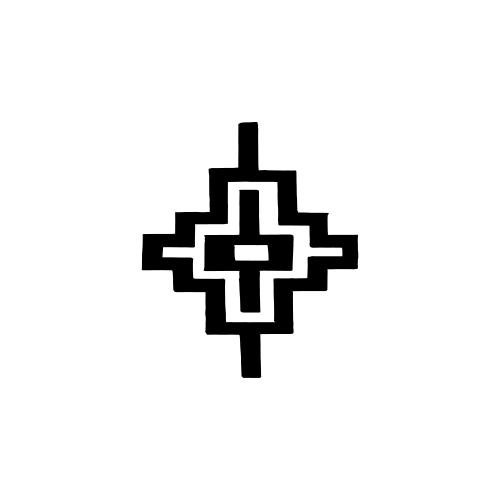 5African pattern does not represent a single style but a range of distinct regional traditions distinguished by construction methods, symbolic vocabularies, and cultural contexts. These traditions have had significant global influence on surface pattern design, particularly in geometric pattern, bold colour use, and symbolic motif design. Key commercial derivatives - especially African wax print - are among the most widely recognised print aesthetics in global fashion.
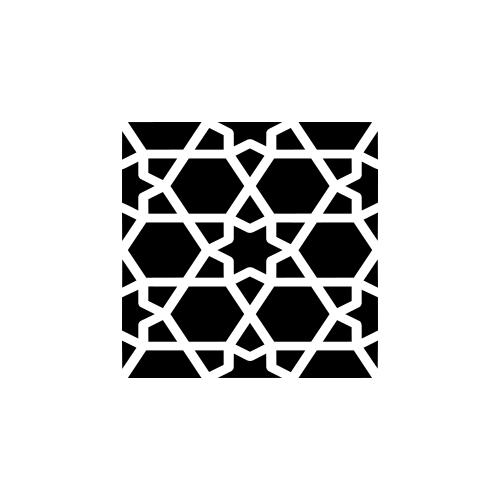 0Arabesque is among the most historically significant and technically sophisticated surface pattern traditions in world design history. Its defining properties - continuous interlacing scrollwork, organic branching structure, and infinite repeatability - make it distinctively suited to all-over surface application. The pattern appears across textiles, tile, metalwork, manuscript illumination, architectural decoration, and wallpaper, and remains commercially active in luxury interiors and premium textile markets.
 1Astrology pattern draws on the graphic language astrology uses to represent relationships between celestial bodies: symbolic glyphs for planetary "aspects" (angles between planets in a horoscope), the twelve zodiac signs grouped into four elemental sets, and - notably for surface pattern - the fact that many of these aspect angles correspond directly to regular star polygons (pentagram, heptagram, octagram, decagram, dodecagram, and more). The source is an astrology reference on aspect theory rather than a design source, so this page focuses on the visual/symbolic vocabulary it documents.
 0Batik is both a technique and a pattern aesthetic. The wax-resist process produces a distinctive line quality and surface character - particularly the organic crackle lines where wax fractures during dyeing - that distinguishes batik from printed textiles. Indonesian batik was inscribed on the UNESCO Intangible Cultural Heritage list in 2009. As a surface pattern aesthetic, batik-inspired design is commercially active in fashion, home textiles, licensing, and print-on-demand markets.
 1Bohemian pattern is defined by its source diversity - drawing simultaneously from Moroccan tilework, Indian block-print traditions, African mudcloth geometry, Native American and Southwestern weavings, and Eastern European folk embroidery. The unifying quality is not any single motif but palette discipline and a hand-made visual register. Home textiles represent the largest commercial market; mandala patterns form the most commercially active subcategory.
 0Celtic knot pattern draws from a documented historical tradition rooted in the illuminated manuscripts, stone carvings, and metalwork of early medieval Ireland, Scotland, and Northumbria. In surface pattern design, the interlace vocabulary of Celtic knotwork functions as a heritage motif with strong commercial associations across Irish, Scottish, and wider British Isles cultural identity. It is particularly active in jewellery design, luxury textiles, stationery, and licensed heritage products. The endless knot - a strand with no visible beginning or end - carries symbolic weight as a motif of eternity and continuity.
 1Damask is simultaneously a weaving technique and a surface pattern aesthetic. As a woven fabric, it is defined by its structure: a warp-faced satin pattern woven against a weft-faced satin ground using the same thread set, producing a reversible fabric where the pattern appears on both sides but in inverse tone. As a pattern aesthetic, damask refers to the large-scale ornamental vocabulary - medallions, scrolls, florals, and architectural forms - that developed through this technique. In surface pattern design, damask motifs are reproduced by printing as well as weaving, and are commercially active in wallpaper, home textiles, and licensing across heritage, formal, and ironically-deployed contexts.
 0Dog pattern draws on one of the oldest and most widespread human-animal relationships. Dogs have been depicted in decorative arts across cultures and centuries - from prehistoric rock carvings and Greek ceramics through Renaissance portraiture and Victorian oil painting to contemporary character illustration. As a surface pattern motif, dog imagery carries strong associations with loyalty, companionship, and domestic life, making it commercially reliable across gifting, home textiles, and lifestyle products. The variety of dog breeds provides a visually rich design vocabulary - from the elegant silhouette of the greyhound through the square-headed bulldog to the fluffy outline of the samoyed.
 0"Ethnic pattern" is an industry-used umbrella term in surface pattern design for work that references the folk art, craft, and decorative traditions of specific nationalities or cultural groups. The Artlandia glossary defines it simply as: "Art typical of a specific nationality or a design based on folk art." In commercial practice the term covers a wide range of regionally specific traditions - ikat, kilim, kente, suzani, tribal, and folk-art motif collections are all sold and described under "ethnic pattern" labelling in the textile and licensing industry. The category is commercially active across fashion, home textiles, accessories, and stationery.
 0The fleur-de-lis is a symmetrical three-part form: a central upward-pointing petal flanked by two outward-curving petals, all bound at the base by a horizontal band or ring. As a surface pattern, it appears in seamless all-over repeats, formal damask compositions, trellis grids, and contemporary minimalist interpretations. Its heritage associations - French royalty, European heraldry, Christian iconography - give it a luxury and classical positioning that remains commercially active across wallpaper, home furnishings, and fashion.
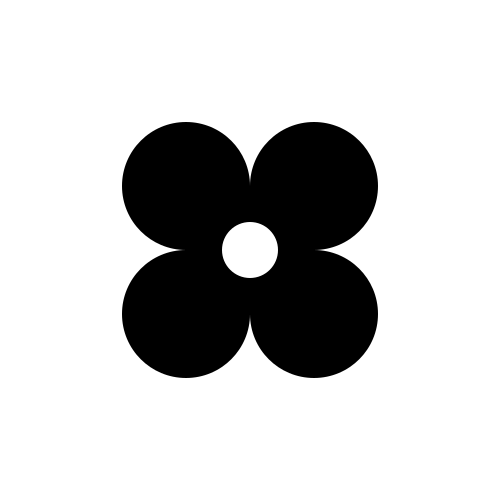 0Floral pattern is the broadest and commercially most active category in surface pattern design. It encompasses any design in which flowers, foliage, stems, and botanical elements constitute the primary visual subject. The category spans a wide range of sub-types - from dense all-over repeats to spaced individual blooms - and includes distinct historical styles with their own visual languages. Floral pattern has been central to textile design across virtually every culture and era, and remains the highest-volume category in wallpaper, fabric, fashion, and home textiles today.
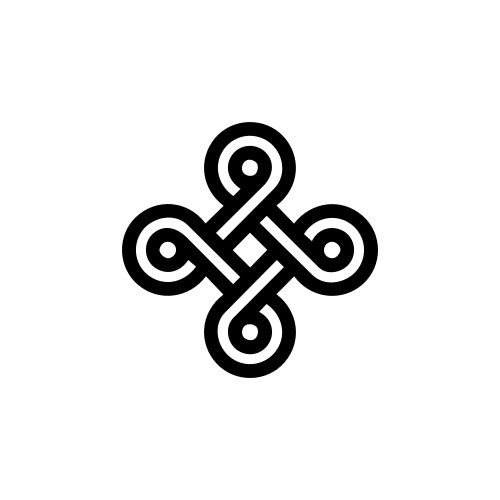 0A frieze pattern is any decorative design that repeats continuously along a single axis, forming a horizontal band or strip. The term comes from classical architecture, where a frieze is the continuous horizontal band between the architrave and cornice of a building facade - typically ornamented with continuous sculptural or painted decoration. In surface pattern design and mathematics, "frieze" refers to the formal class of one-dimensional repeating patterns: designs with translational symmetry in exactly one direction. There are exactly seven distinct frieze symmetry groups (the "seven frieze groups"), making this a well-defined structural category with direct relevance to border pattern design.
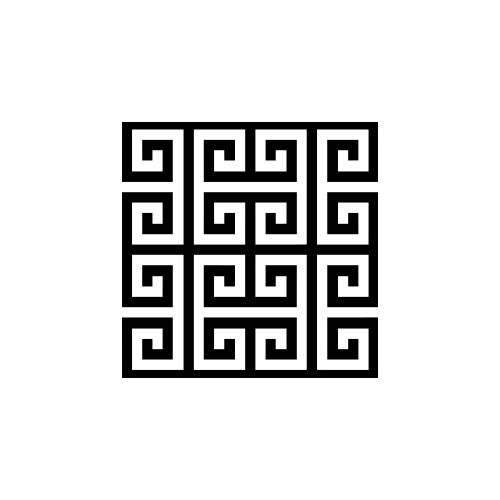 0The Greek key (or meander) is a continuous geometric border motif formed by a single line turning back on itself at right angles to create a square spiral or labyrinthine sequence. It is one of the most historically persistent ornamental motifs in the world, appearing independently in ancient Chinese bronzes, Mesoamerican design, and classical Greek pottery before becoming a defining ornamental element of Neoclassical, Beaux-Arts, and Art Deco design. In surface pattern design, the Greek key is commercially active as a border, stripe, and all-over repeat in luxury interiors, fashion accessories, and licensing.
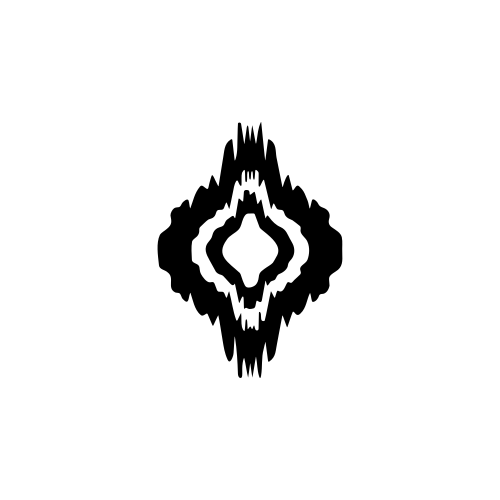 0Ikat is a resist-dyeing technique in which the yarn - warp, weft, or both - is bound and dyed before the fabric is woven. Unlike batik, which applies resist to finished cloth, ikat applies resist to the thread before weaving. The bound portions of yarn resist the dye; when the bindings are removed and the yarn is woven, the pre-dyed pattern appears in the cloth. Because the alignment of dyed yarn sections during weaving is never perfectly precise, ikat produces a characteristic soft-edged or slightly blurred version of the intended pattern - this "ikat blur" or "ikat feathering" is the defining visual characteristic of the technique and a primary aesthetic marker in ikat-inspired surface design. The word "ikat" derives from the Malay-Indonesian mengikat - "to tie" or "to bind."
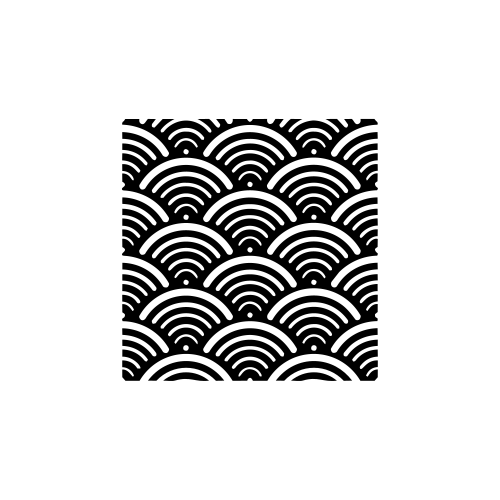 0"Oriental pattern" is an industry umbrella term rather than a precise technical category. In commercial contexts it typically refers to patterns drawing on the visual vocabulary of oriental carpets (Turkish, Persian, Caucasian, Central Asian, and Chinese), on Chinese and Japanese decorative motifs, or on the broader Orientalist aesthetic that shaped European design from the 16th century onwards. The term encompasses designs of considerable complexity and cultural depth - from the strict geometric traditions of Anatolian Seljuq carpet design (13th century) through the floral elaboration of Safavid Persian court carpet to the chinoiserie-influenced surface patterns of 18th-century European textiles. In contemporary commercial use, it typically signals formal, richly decorated, tradition-referencing pattern design. Note on terminology: "Oriental" as a descriptor has been contested in some cultural and academic contexts; "Islamic", "Persian", "Anatolian", "Central Asian", or specific regional names are often more precise when attribution is known.
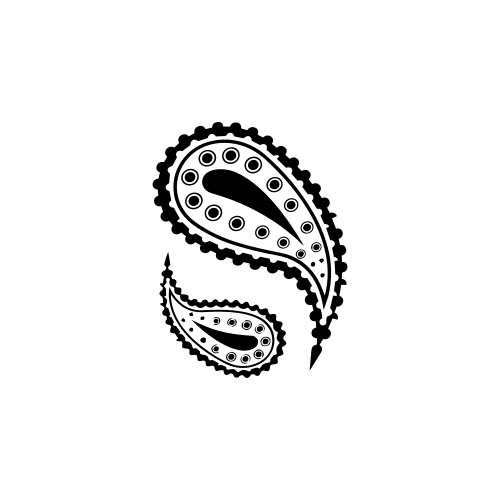 0Paisley is a curved, teardrop-shaped motif with a characteristic bent or curved upper end. The motif originated in Iranian and Persian decorative art - where it is called boteh or buta - and entered the European market through the importation of Kashmir shawls from the 17th century onwards. Its English name comes from Paisley, the Scottish town whose Jacquard-loom weavers became the dominant European producers of paisley-pattern fabric in the 19th century. Paisley is one of the most commercially enduring pattern types in Western fashion, with documented presence from early 19th-century bandanas through to continuous contemporary production. It is known by different names in different cultures: "mango" in most Indian and South Asian languages; "cucumbers" in Russia; "ham hock pattern" in China; "boteh," "cachemire," or "palme" in French design vocabulary.
 0The quatrefoil (from Old French: "four leaves") is a specific geometric shape: four circles of equal diameter, each overlapping its neighbours, arranged so their centres define a square. The resulting outline is a four-lobed form with pointed intersections between adjacent lobes - resembling a four-leaf clover, a four-petalled flower, or a rounded cross. As a decorative motif it has been used continuously across at least 1,500 years, appearing in early Christian architecture, Islamic design, Gothic tracery, Renaissance decorative arts, and contemporary interiors. It carries consistent cultural associations with heritage, formality, and luxury, positioning it commercially as a premium interior and fashion motif.
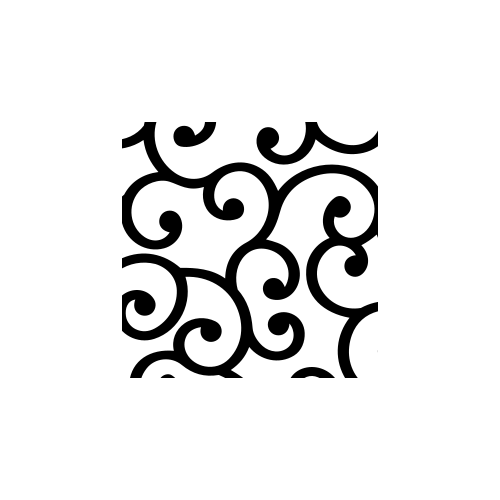 0The scroll pattern is an ornamental system built from the logic of plant growth: a continuous stem that branches, curls, and spirals, producing a flowing, all-over structure that can fill any surface without obvious repeat. Unlike grid-based geometric patterns, scroll patterns follow organic rhythms - mirroring the way vines, tendrils, and climbing plants ramify through space. This structural flexibility has made scroll patterns one of the most versatile and durable motif traditions in decorative history. They appear as architectural borders, woven textile structures, painted ceramic ornament, carved stone relief, and printed wallpaper. In surface pattern design, they translate naturally into all-over repeating structures with strong commercial applications across wallpaper, furnishing fabric, fashion, and heritage design reproduction.
 0The star is a radial geometric motif formed from a star polygon or polygonal compound, named for its resemblance to the diffraction spikes of astronomical stars. Stars appear across heraldry, religious iconography, flags, and badges, with different point-counts carrying distinct and often unrelated symbolic meanings depending on the culture and context. As a surface pattern motif, the star's appeal comes from this combination of simple, highly legible geometry and layered symbolic weight.
You've reached the end
19 Types