Celtic knot pattern draws from a documented historical tradition rooted in the illuminated manuscripts, stone carvings, and metalwork of early medieval Ireland, Scotland, and Northumbria. In surface pattern design, the interlace vocabulary of Celtic knotwork functions as a heritage motif with strong commercial associations across Irish, Scottish, and wider British Isles cultural identity. It is particularly active in jewellery design, luxury textiles, stationery, and licensed heritage products. The endless knot - a strand with no visible beginning or end - carries symbolic weight as a motif of eternity and continuity.
We use cookies to improve your experience and understand how PatternDesigners is used.
Celtic knot pattern draws from a documented historical tradition rooted in the illuminated manuscripts, stone carvings, and metalwork of early medieval Ireland, Scotland, and Northumbria. In surface pattern design, the interlace vocabulary of Celtic knotwork functions as a heritage motif with strong commercial associations across Irish, Scottish, and wider British Isles cultural identity. It is particularly active in jewellery design, luxury textiles, stationery, and licensed heritage products. The endless knot - a strand with no visible beginning or end - carries symbolic weight as a motif of eternity and continuity.
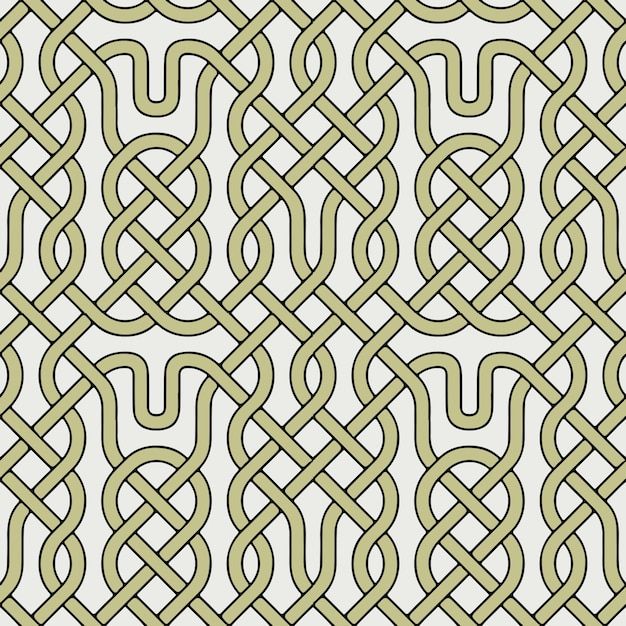
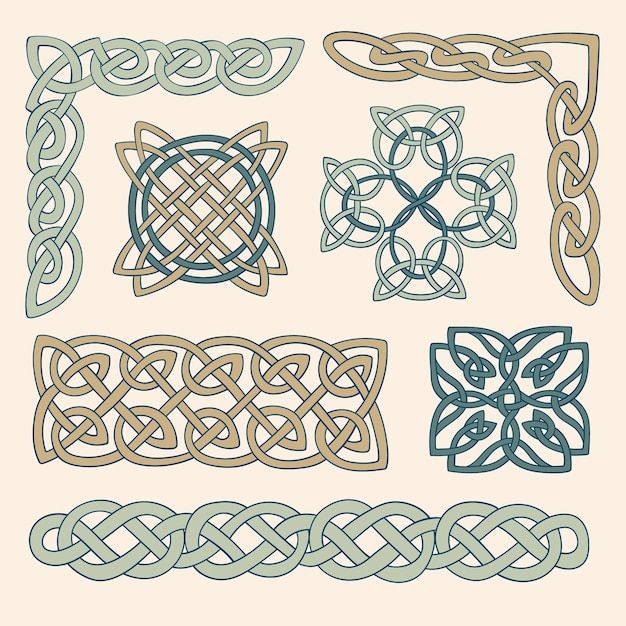
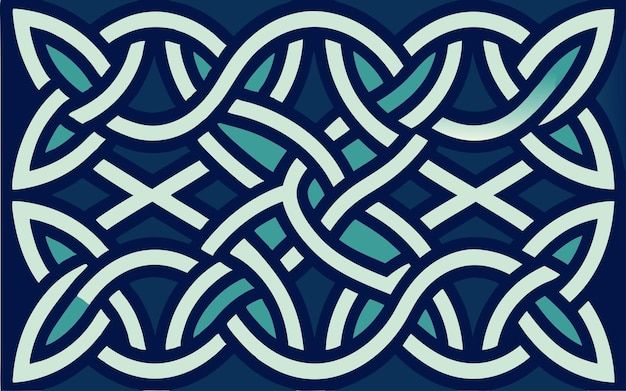
Celtic knot pattern is defined by interlaced linear strands that cross over and under one another in regular sequence, forming continuous loops. The visual surface is typically dense and organised - the strands fill the available space without gaps. Key visual qualities include: the regularity of the over-under weaving sequence, the smooth, ribbon-like quality of the strand, the bilateral or rotational symmetry of many compositions, and the sense of spatial depth created by the crossing structure. Border and frame compositions are particularly common - long linear knotwork bands that frame illuminated text or decorative panels.
Celtic knotwork is constructed on an underlying grid. The strand path follows a systematic route across the grid, crossing at prescribed intervals to produce the interlaced effect. J. Romilly Allen identified eight elementary knot types as the building blocks of Celtic interlace. More complex knots are produced by combining, expanding, or interlocking these elements. The endless knot - a closed loop with no terminal - is a subset of this system. Basket weave knots use a more regular, orthogonal crossing structure than the more complex interlaced plaitwork. In all-over repeat application, Celtic knotwork can tile as a seamless interlace surface.
Historical Celtic knotwork in manuscripts (Book of Kells, Lindisfarne Gospels) uses a rich, warm palette: ultramarine, vermilion, gold, green, and purple on vellum grounds. Contemporary surface pattern applications typically use limited, high-contrast palettes - often gold or silver on dark grounds for jewellery and luxury products, or outlined black on white for tattoo and stationery applications. Heritage textile applications often use green, gold, and earth tones with clear Celtic cultural reference.
The interlace pattern tradition that produced Celtic knotwork originated in late Roman Empire floor mosaics of the 3rd-4th century AD. The specific broken-and-reconnected plait form characteristic of Insular Celtic knotwork developed in northern Italy and southern Gaul and spread to Ireland by the 7th century. It was developed to its greatest elaboration in the illuminated manuscripts of the Insular period - particularly the Book of Kells (c. 800 AD) and the Lindisfarne Gospels (c. 715 AD) - and in the carved stone crosses and metalwork of Celtic Christianity. The tradition represents a convergence of Roman, Eastern Christian, and northern European artistic practices. Celtic knot tattoo designs became widely popular in the United States from the 1970s-80s, expanding the commercial market for Celtic interlace motifs in consumer surface design beyond its earlier craft and heritage applications.
Celtic knot pattern draws from a documented historical tradition rooted in the illuminated manuscripts, stone carvings, and metalwork of early medieval Ireland, Scotland, and Northumbria.
Celtic knot pattern is defined by interlaced linear strands that cross over and under one another in regular sequence, forming continuous loops. The visual surface is typically dense and organised - the strands fill the available space without gaps.
Heritage
Celtic knotwork is constructed on an underlying grid. The strand path follows a systematic route across the grid, crossing at prescribed intervals to produce the interlaced effect. J. Romilly Allen identified eight elementary knot types as the building blocks of Celtic interlace.
Emblem
Historical Celtic knotwork in manuscripts (Book of Kells, Lindisfarne Gospels) uses a rich, warm palette: ultramarine, vermilion, gold, green, and purple on vellum grounds.
The interlace pattern tradition that produced Celtic knotwork originated in late Roman Empire floor mosaics of the 3rd-4th century AD. The specific broken-and-reconnected plait form characteristic of Insular Celtic knotwork developed in northern Italy and southern Gaul and spread to Ireland by the 7th century.
Arabesque Pattern