Types
 0In surface pattern design, black functions as both background and foreground - an anchor tone that intensifies other colours and lends authority, formality, and graphic weight to a composition. Black-dominant patterns span high fashion, luxury interiors, stationery, and accessories, where the colour signals sophistication, elegance, and contrast. It is commercially versatile: equally at home in minimalist modernist prints and in richly decorative dark-ground florals or toiles.
 0Celtic knot pattern draws from a documented historical tradition rooted in the illuminated manuscripts, stone carvings, and metalwork of early medieval Ireland, Scotland, and Northumbria. In surface pattern design, the interlace vocabulary of Celtic knotwork functions as a heritage motif with strong commercial associations across Irish, Scottish, and wider British Isles cultural identity. It is particularly active in jewellery design, luxury textiles, stationery, and licensed heritage products. The endless knot - a strand with no visible beginning or end - carries symbolic weight as a motif of eternity and continuity.
 0Ghost pattern is a conversational/novelty print type defined by its motif: the ghost - a simplified, typically friendly or cute figure drawn from Halloween and popular culture iconography. In surface pattern design, ghost patterns appear most actively in seasonal Halloween product ranges: children's apparel, home textiles, wrapping paper, party supplies, and stationery. A separate but related use of "ghost pattern" in graphic and digital design refers to a faint, low-contrast background texture - a subtle pattern using near-matched tones to add visual depth without distracting from foreground content.
 0Halloween pattern is a major commercial category in the seasonal surface design market, ranked alongside Christmas and Easter as one of the three biggest seasonal pattern opportunities. The commercial window runs from August through October, giving designers significant lead time for seasonal product. The market has segmented significantly in recent years - the traditional orange-and-black children's aesthetic is now just one of five recognised commercial directions, with adult-targeted pastel Halloween, vintage, and witchy/cottagecore aesthetics commanding significant and growing market share. Origins in the Celtic festival of Samhain (c. 1st century BC) provide a deep symbolic vocabulary that designers continue to draw from.
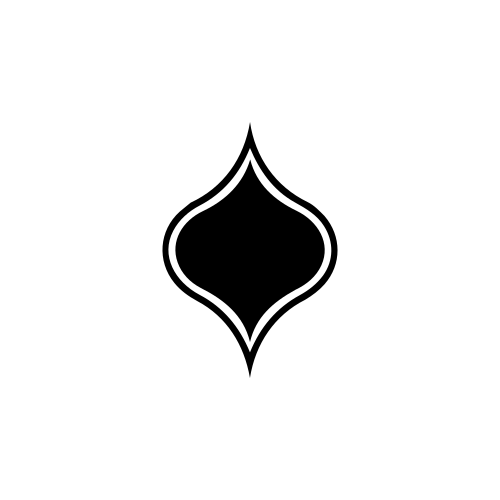 0The ogee is defined geometrically as a double curve in which a concave arc flows smoothly into a convex arc (or vice versa), forming an elongated S-shape. In surface pattern design, the ogee motif is deployed as a repeating unit that interlocks with its neighbours to cover a plane seamlessly - producing the characteristic field of pointed oval or onion-dome shapes. The ogee pattern appears in textiles as early as the 12th century and has been a continuous feature of decorative arts through the Gothic and Renaissance periods to the present day. It is commercially associated with wallpaper, damask fabric, furnishing textiles, and high-end interior design. The shape's elegant proportions and historical pedigree give it a luxury and heritage positioning across markets.
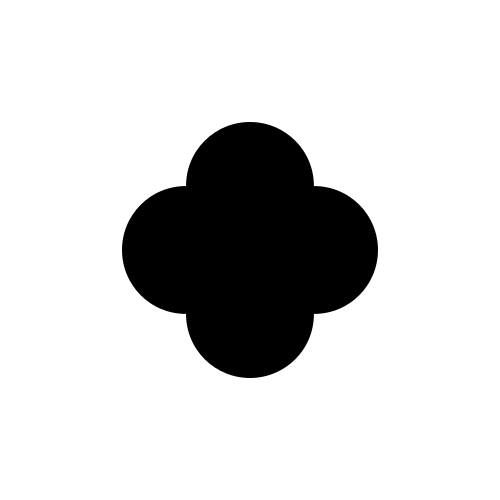 0The quatrefoil (from Old French: "four leaves") is a specific geometric shape: four circles of equal diameter, each overlapping its neighbours, arranged so their centres define a square. The resulting outline is a four-lobed form with pointed intersections between adjacent lobes - resembling a four-leaf clover, a four-petalled flower, or a rounded cross. As a decorative motif it has been used continuously across at least 1,500 years, appearing in early Christian architecture, Islamic design, Gothic tracery, Renaissance decorative arts, and contemporary interiors. It carries consistent cultural associations with heritage, formality, and luxury, positioning it commercially as a premium interior and fashion motif.
You've reached the end
6 Types