Types
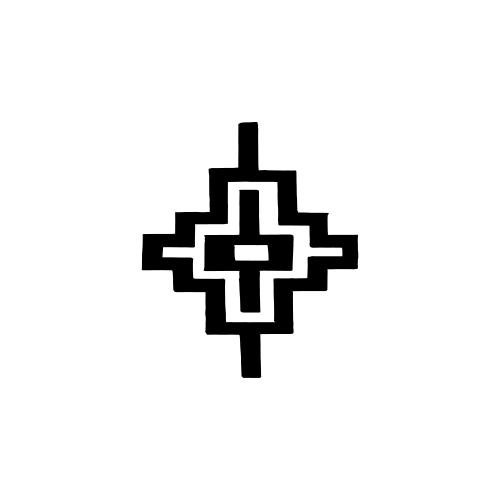 5African pattern does not represent a single style but a range of distinct regional traditions distinguished by construction methods, symbolic vocabularies, and cultural contexts. These traditions have had significant global influence on surface pattern design, particularly in geometric pattern, bold colour use, and symbolic motif design. Key commercial derivatives - especially African wax print - are among the most widely recognised print aesthetics in global fashion.
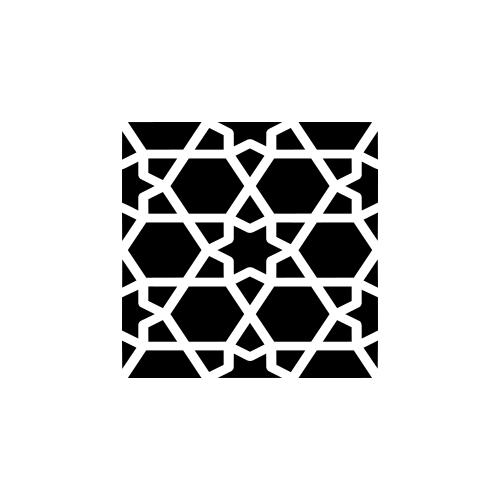 0Arabesque is among the most historically significant and technically sophisticated surface pattern traditions in world design history. Its defining properties - continuous interlacing scrollwork, organic branching structure, and infinite repeatability - make it distinctively suited to all-over surface application. The pattern appears across textiles, tile, metalwork, manuscript illumination, architectural decoration, and wallpaper, and remains commercially active in luxury interiors and premium textile markets.
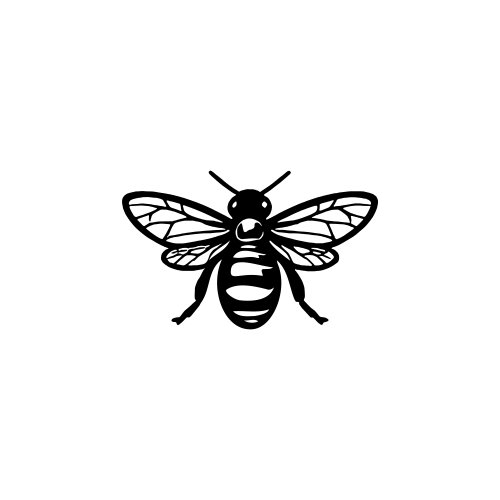 0Bee patterns span two distinct visual registers: the figurative bee motif (stylized or detailed insects) and the structural honeycomb grid (hexagonal geometry abstracted from comb construction). Both forms are commercially active, often combined in the same repeat. The bee carries strong symbolic associations - community, hard work, nature, sustainability - that give the pattern appeal for eco-positioned brands and artisan lifestyle markets.
 0Celtic knot pattern draws from a documented historical tradition rooted in the illuminated manuscripts, stone carvings, and metalwork of early medieval Ireland, Scotland, and Northumbria. In surface pattern design, the interlace vocabulary of Celtic knotwork functions as a heritage motif with strong commercial associations across Irish, Scottish, and wider British Isles cultural identity. It is particularly active in jewellery design, luxury textiles, stationery, and licensed heritage products. The endless knot - a strand with no visible beginning or end - carries symbolic weight as a motif of eternity and continuity.
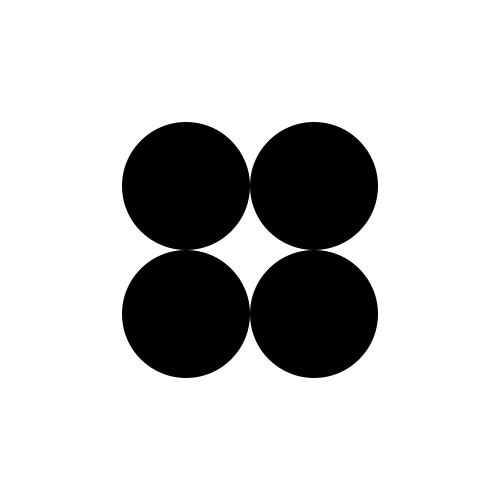 0Circle pattern is a broad geometric category in surface design, encompassing everything from the commercial simplicity of the polka dot to the sacred geometry associations of the Flower of Life overlapping-circles grid. The circle as a design element is commercially universal - it appears in children's textiles, modernist fashion prints, home decor, jewellery, and stationery. The overlapping circles grid specifically carries documented use from ancient Assyrian decoration through Roman Empire architecture, Islamic geometric art, and Gothic stonework - giving it both deep historical roots and active contemporary market relevance.
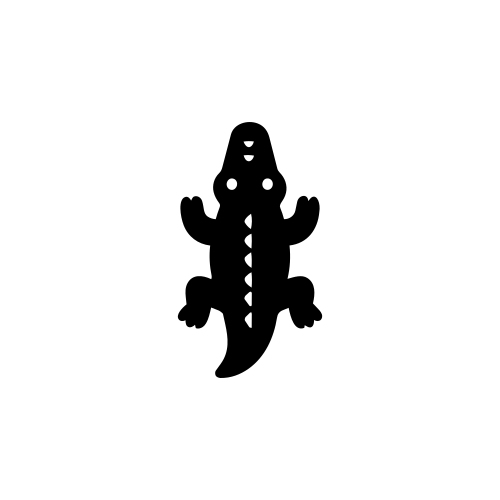 0Crocodile pattern translates the distinctive surface geometry of crocodile hide into a repeating surface design. The pattern is defined by the irregular but systematic tiling of scute-like forms - the bony, horny scales that cover the crocodile's body - arranged in a continuous all-over texture. As a surface pattern type, it belongs to the broader category of reptile-print and animal-skin textures, which have enduring commercial relevance in luxury fashion.
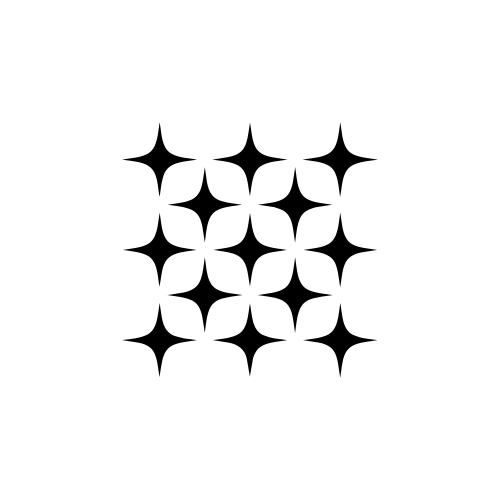 0The diaper pattern is defined by the regular repetition of a simple geometric unit - typically a diamond or lozenge - spaced evenly to create an unbroken field across the fabric. The pattern belongs to the damask family of woven cloth but is distinguished by the small scale of its repeat unit and the simplicity of its geometric form. It has been a consistent presence in European and South Asian textile traditions for centuries, produced in silk, linen, and cotton across distinct cultural weaving practices.
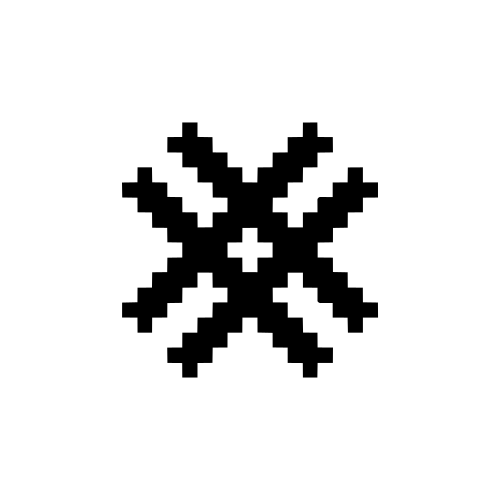 0"Ethnic pattern" is an industry-used umbrella term in surface pattern design for work that references the folk art, craft, and decorative traditions of specific nationalities or cultural groups. The Artlandia glossary defines it simply as: "Art typical of a specific nationality or a design based on folk art." In commercial practice the term covers a wide range of regionally specific traditions - ikat, kilim, kente, suzani, tribal, and folk-art motif collections are all sold and described under "ethnic pattern" labelling in the textile and licensing industry. The category is commercially active across fashion, home textiles, accessories, and stationery.
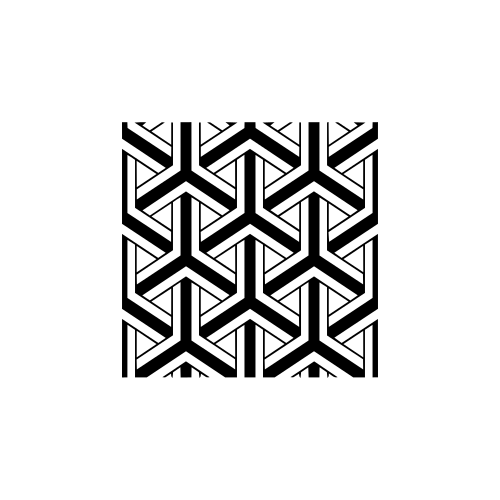 0Geometric pattern uses mathematical forms - triangles, squares, hexagons, circles, diamonds, and their combinations - as the primary structural and visual element. It is among the oldest and most widespread pattern categories in human decorative art, with major traditions in Islamic art, pre-Columbian textile design, Japanese textile design, and European architectural ornament. In contemporary surface pattern design, geometric pattern spans the full spectrum from rigorous mathematical tiling systems to loose, hand-drawn geometric aesthetics, and is commercially active across all market sectors.
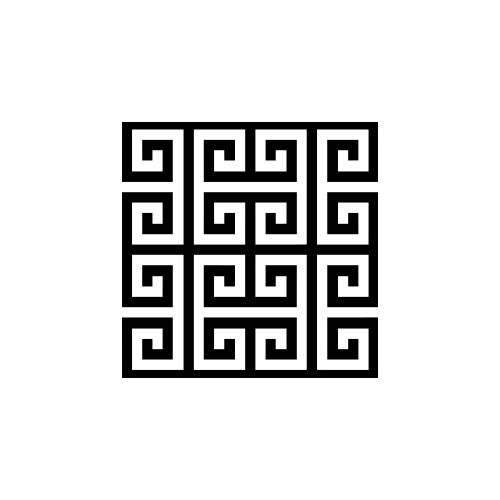 0The Greek key (or meander) is a continuous geometric border motif formed by a single line turning back on itself at right angles to create a square spiral or labyrinthine sequence. It is one of the most historically persistent ornamental motifs in the world, appearing independently in ancient Chinese bronzes, Mesoamerican design, and classical Greek pottery before becoming a defining ornamental element of Neoclassical, Beaux-Arts, and Art Deco design. In surface pattern design, the Greek key is commercially active as a border, stripe, and all-over repeat in luxury interiors, fashion accessories, and licensing.
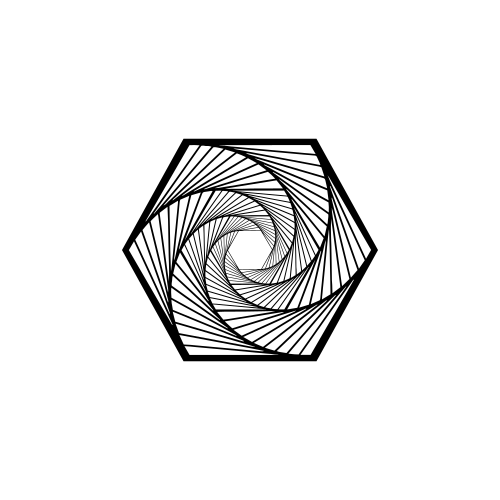 0Guilloché (from the French, after an engraver named Guillot) refers to both a machine engraving technique and the pattern it produces. The technique uses a precision lathe (engine-turning machine, or tour à guillocher) to engrave continuous overlapping geometric curves - spirals, wave forms, and interlaced circles - into a metal surface with extreme regularity and fine detail. The resulting pattern has a characteristic lace-like quality: densely regular, optically complex, and impossible to reproduce by hand. In the broader decorative arts, "guilloché" also describes the architectural motif of interlacing overlapping spirals. In surface pattern design, the guilloché aesthetic is referenced for its precision, luxury associations, and optical depth.
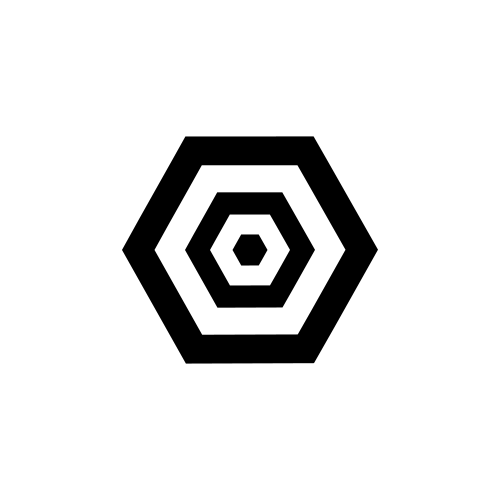 0The hexagon pattern is built from regular hexagons - six-sided polygons with equal sides and 120-degree internal angles. Three hexagons meet at each vertex, which accounts for the full 360 degrees and produces a mathematically stable, gapless tessellation. In surface pattern design, this structure appears in two primary forms: the pure geometric grid, and the nature-referencing honeycomb, where the hexagonal cells evoke beeswax construction. The hexagonal tessellation has mathematical properties that make it widely useful: it covers a plane surface with the least total perimeter for a given area (the honeycomb theorem), and circles inscribed within hexagonal cells achieve the densest possible two-dimensional packing. These structural efficiencies have contributed to the form's persistence across many decorative and applied design traditions.
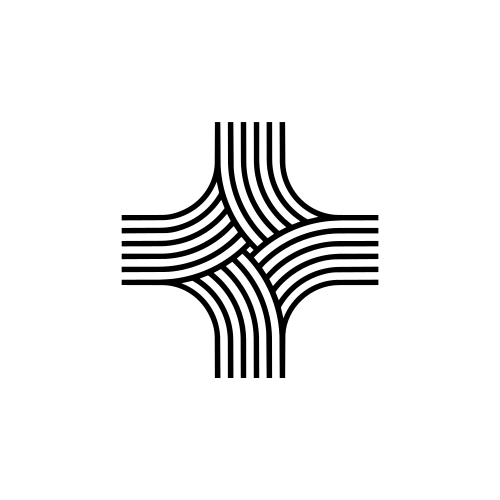 0Interlocking patterns are built on the principle that changing or removing one element disrupts the whole composition. Individual units - circles, squares, organic shapes, or custom forms - combine with their neighbour's negative space to produce a continuous, gap-free surface. The pattern depends on the designed relationship between every element rather than on any single isolated motif. This compositional principle is closely related to tessellation but extends beyond strict geometric tiling to include organic or custom-shaped elements that interlock through deliberate design. The result is a surface with no visible background: the entire field is occupied by the interlocking units.
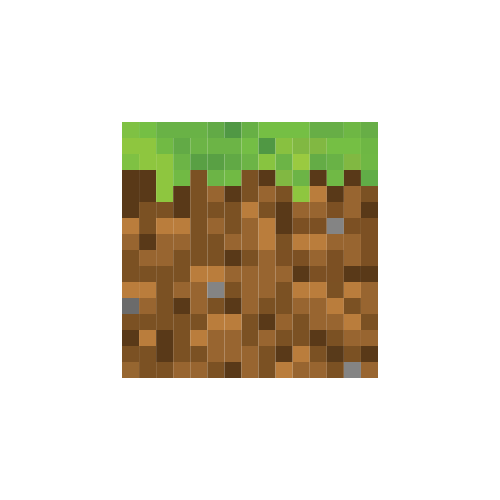 0Minecraft pattern draws its visual identity from the game's core building unit, the "block" - a 1-cubic-metre cell arranged in a three-dimensional grid, with each face rendered from a small square texture. This gives the motif category a distinctive, instantly recognisable look: hard-edged cubes and a visible low-resolution pixel grain, rather than smooth or painterly surfaces. The source is a game-reference article on block mechanics rather than a design source, so this page draws only on the visual/structural facts it documents.
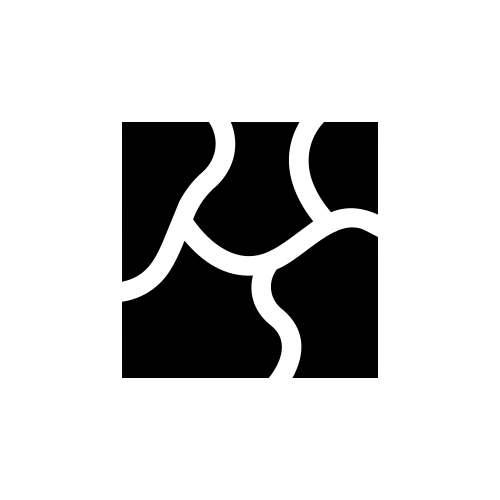 0Mosaic pattern refers to surface designs that either replicate or reference the visual appearance of traditional mosaic - artworks and decorative surfaces made from small pieces of coloured stone, glass, ceramic, or other materials (tesserae) set in mortar or plaster. As a surface pattern category, mosaic pattern encompasses: direct simulation of tesserae arrangements (small square or irregular coloured tile-like units); geometric tile compositions (particularly Islamic zellij and Byzantine mosaic traditions); and the broader visual aesthetic of tessellated coloured surfaces. Mosaic pattern is commercially active in tile design, printed wallpaper and fabric, and as an art-historical reference in luxury and heritage surface design.
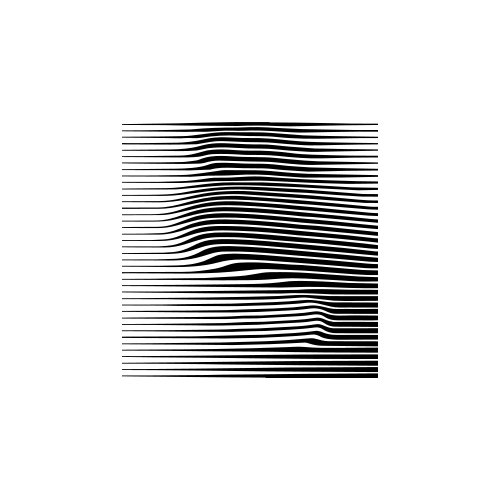 0Natural patterns are regular structures produced by physical, biological, and mathematical processes operating in living organisms and non-living physical systems. For surface pattern designers, patterns in nature are among the most important reference sources - providing the visual vocabulary of organic geometry, the colour relationships of natural pigmentation, and the structural logic of systems that repeat at multiple scales. The recognition that all natural patterns arise from a small set of underlying mechanisms - symmetry, reaction-diffusion, Fibonacci sequence, fractal iteration - gives surface designers a conceptual framework for generating and analysing naturally-inspired surface design work.
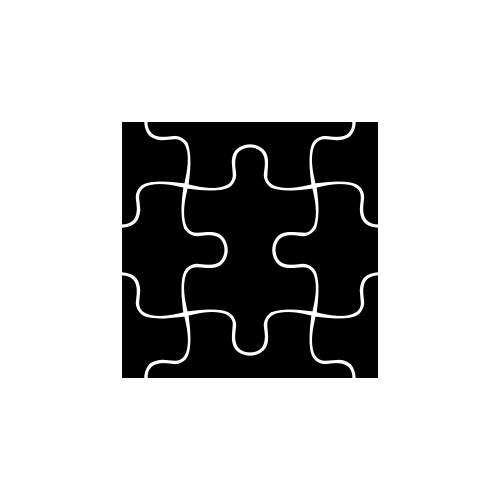 0The puzzle pattern draws on the visual vocabulary of physical puzzles - objects designed to be taken apart or reassembled, most recognisably the jigsaw puzzle. The source is a general Wikipedia article on puzzles as a category of game and toy, not a textile or surface pattern reference, so the motif's design use is inferred narrowly from the shapes and objects it describes rather than documented directly.
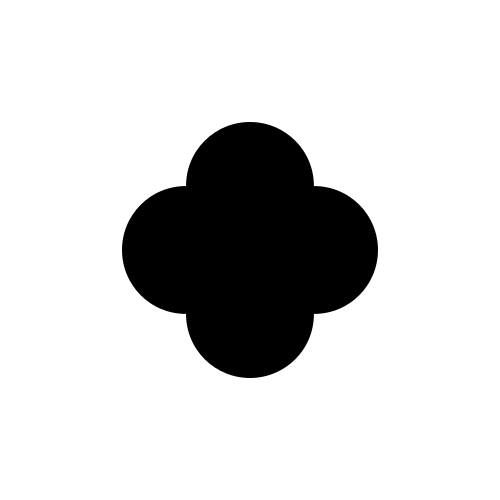 0The quatrefoil (from Old French: "four leaves") is a specific geometric shape: four circles of equal diameter, each overlapping its neighbours, arranged so their centres define a square. The resulting outline is a four-lobed form with pointed intersections between adjacent lobes - resembling a four-leaf clover, a four-petalled flower, or a rounded cross. As a decorative motif it has been used continuously across at least 1,500 years, appearing in early Christian architecture, Islamic design, Gothic tracery, Renaissance decorative arts, and contemporary interiors. It carries consistent cultural associations with heritage, formality, and luxury, positioning it commercially as a premium interior and fashion motif.
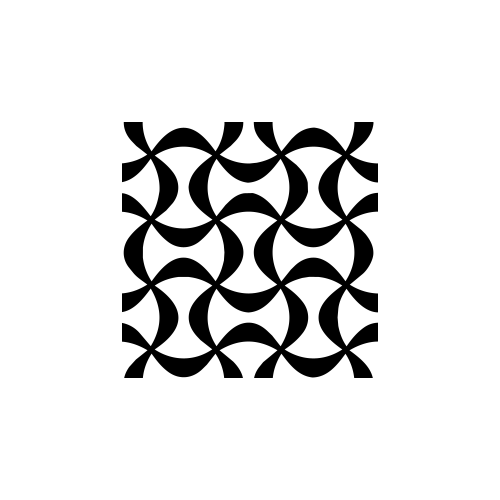 0Tessellation is the covering of a surface with one or more geometric shapes so that they fit together with no gaps and no overlaps. A periodic tiling repeats regularly; a regular tessellation uses identical regular-polygon tiles meeting identically at every corner. Only three shapes can tile a plane on their own this way: the equilateral triangle, the square, and the regular hexagon. Semi-regular tessellations combine more than one regular polygon while keeping the same arrangement at every vertex - there are eight of these. Beyond regular and semi-regular tiling, tessellations can also be built from irregular polygons, pentagons, or almost any interlocking shape, as popularised by M. C. Escher's animal- and figure-shaped tiles.
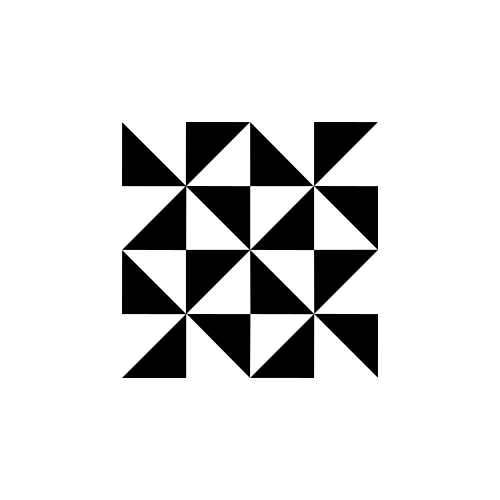 0Triangle patterns exploit the fundamental visual properties of the three-sided polygon: directionality (a triangle always points somewhere), the visual contrast between its flat base and sharp apex, and its ability to tile surfaces perfectly with no gap or overlap. In surface pattern, triangles function both as individual repeated motifs and as the structural unit of more complex geometric arrangements. The motif's associations - with stability, power, hierarchy, and dynamic energy - make it a versatile tool across a wide range of design contexts.
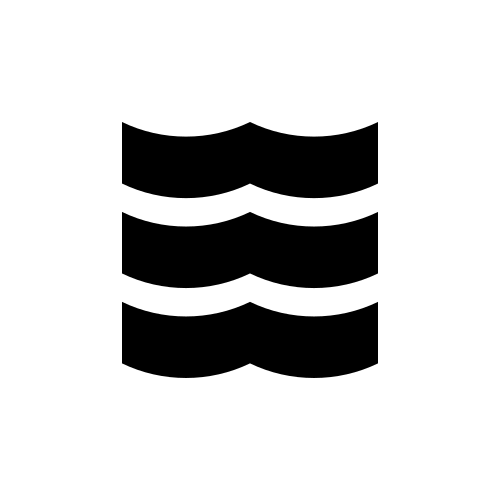 0Wave patterns draw on one of the most universally recognised natural forms: the curved, rising-and-falling profile of a water wave. In surface pattern design, wave structures range from simple sinusoidal line patterns through to complex, layered representations of ocean swells and breaking waves. The category encompasses both highly geometric, abstract wave forms and naturalistic sea imagery. Wave patterns carry consistent psychological associations with movement, rhythm, and the natural world, making them commercially versatile across fashion, home design, and digital applications.
You've reached the end
21 Types