Paisley is a curved, teardrop-shaped motif with a characteristic bent or curved upper end. The motif originated in Iranian and Persian decorative art - where it is called boteh or buta - and entered the European market through the importation of Kashmir shawls from the 17th century onwards. Its English name comes from Paisley, the Scottish town whose Jacquard-loom weavers became the dominant European producers of paisley-pattern fabric in the 19th century. Paisley is one of the most commercially enduring pattern types in Western fashion, with documented presence from early 19th-century bandanas through to continuous contemporary production. It is known by different names in different cultures: "mango" in most Indian and South Asian languages; "cucumbers" in Russia; "ham hock pattern" in China; "boteh," "cachemire," or "palme" in French design vocabulary.
We use cookies to improve your experience and understand how PatternDesigners is used.
Paisley is a curved, teardrop-shaped motif with a characteristic bent or curved upper end. The motif originated in Iranian and Persian decorative art - where it is called boteh or buta - and entered the European market through the importation of Kashmir shawls from the 17th century onwards. Its English name comes from Paisley, the Scottish town whose Jacquard-loom weavers became the dominant European producers of paisley-pattern fabric in the 19th century. Paisley is one of the most commercially enduring pattern types in Western fashion, with documented presence from early 19th-century bandanas through to continuous contemporary production. It is known by different names in different cultures: "mango" in most Indian and South Asian languages; "cucumbers" in Russia; "ham hock pattern" in China; "boteh," "cachemire," or "palme" in French design vocabulary.
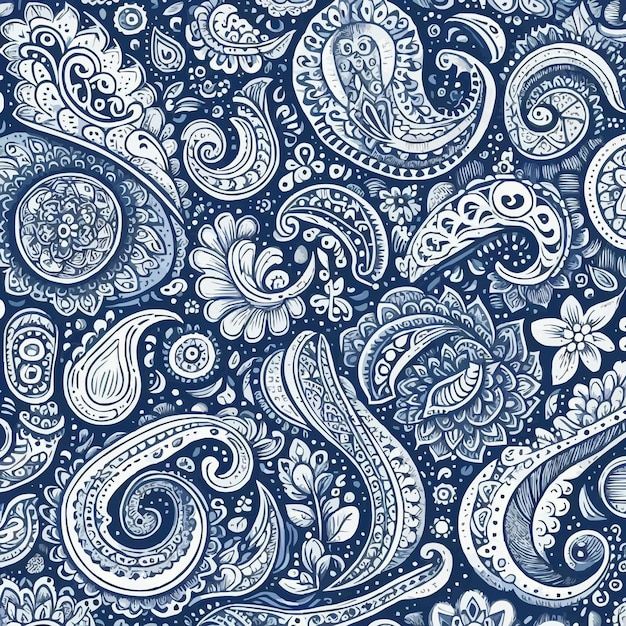
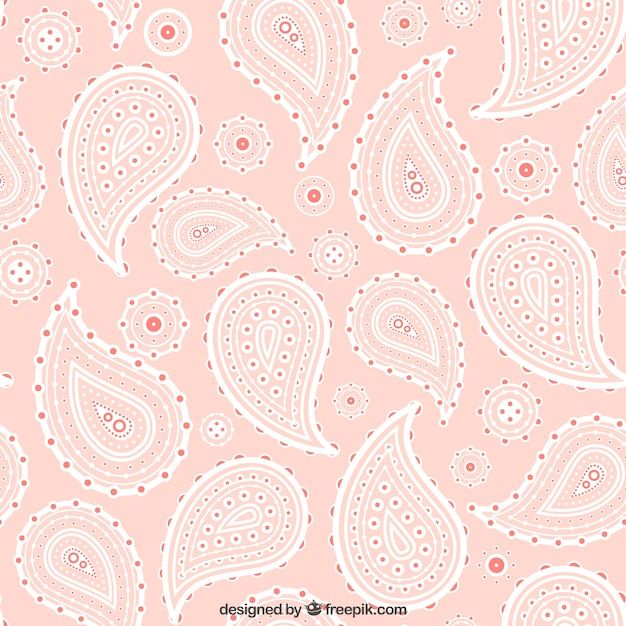
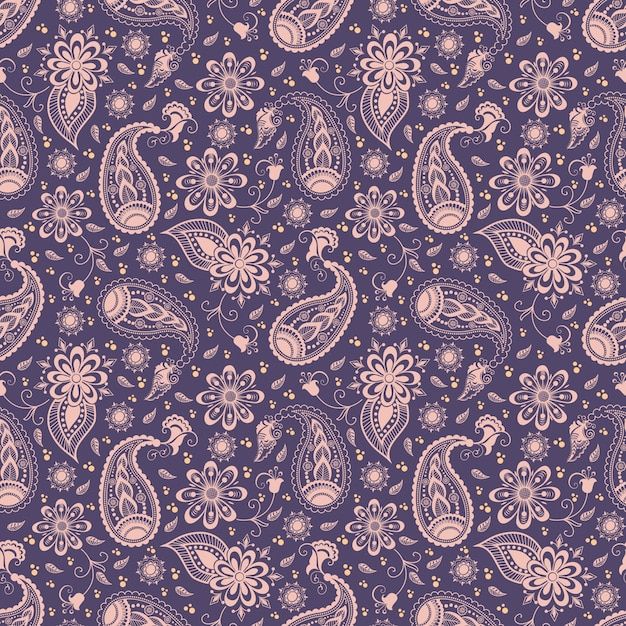
The paisley motif is defined by its teardrop-shaped body with a curved or bent upper end - the characteristic curving tip that distinguishes it from a plain teardrop or droplet form. The interior of the motif is densely filled with subsidiary ornamental elements: smaller floral forms, leaves, dots, fine scrollwork, and geometric fill. The motif is typically surrounded by secondary fill elements. The overall effect is richly ornamental - paisley compositions are dense, fine-detailed, and complex. Scale varies from very small (micro paisley for scarves and accessories) to large (bold oversized paisleys for fashion print).
Paisley is most commonly used in all-over repeat format - individual or clustered paisley motifs distributed across the surface in tossed, half-drop, or directional arrangements. A characteristic traditional paisley composition uses a central large boteh motif with the curved tip pointing in one direction (the "mango" or "cone" form), repeated across the surface with fill ornament between. Paisley is also used as: a border strip (narrow repeating paisley along a hem or edge); a contained medallion composition; and a single large placement motif.
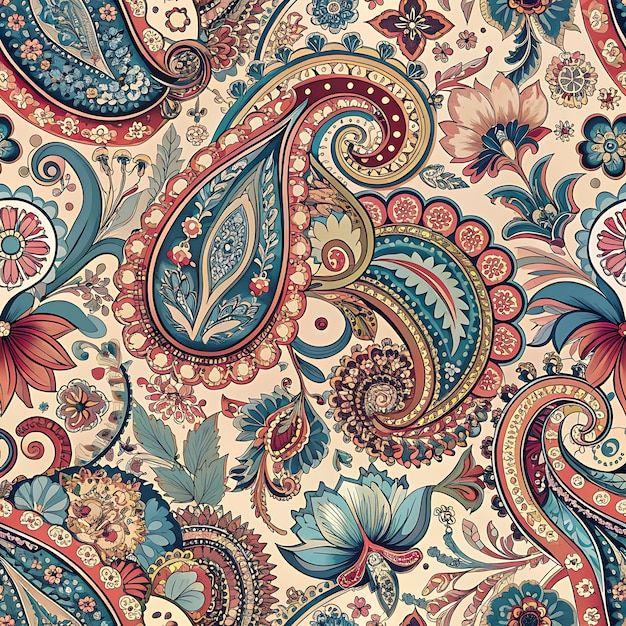
Traditional Kashmir and Indian paisley uses rich, saturated colour - deep reds, blues, greens, and golds against cream or contrasting grounds. European 19th-century Paisley and Norwich production evolved the palette within these conventions. Bandana paisley (from the early 1800s) uses the characteristic red/navy-on-white or white-on-red/navy palette that remains commercially dominant for bandana products. 1960s fashion revival (Beatles era) used bold, psychedelic paisley palettes. Contemporary commercial paisley spans everything from heritage-exact Kashmir reproduction to vivid fashion colour to monochromatic single-colour treatments.
The earliest documented appearance of the boteh motif in decorative art is at the Noh Gumba mosque in Balkh, Afghanistan, dated to the 800s. The motif moved from Iran to Kashmir approximately in the 1400s, becoming established in the Kashmir shawl weaving tradition. The Kashmir shawl - woven in fine goat-fibre wool using complex twill weave and twill-tapestry techniques - became a major luxury export good, reaching European aristocratic consumers through the British and Dutch East India Companies. The Mughal Emperor Akbar wore two Kashmir shawls simultaneously as a status symbol, establishing the shawl's prestige association. European commercial interest drove the development of Jacquard-loom weaving in Western textile centres - Paisley, Scotland became the dominant production centre, reaching five-colour production capability by 1820 and fifteen colours by 1860. Bandana paisley production began in the early 1800s. The pattern's commercial peak in Western fashion was approximately 1800-1870. The 1960s Beatles-era revival, and subsequent associations with Prince (whose record label and studio complex was named Paisley Park), Queen, and David Bowie, gave the pattern a rock-music cultural register that continues in commercial use. Today paisley is commercially active in neckties, waistcoats, scarves, womenswear, wallpaper, cushions, and bedding.
Paisley is a curved, teardrop-shaped motif with a characteristic bent or curved upper end. The motif originated in Iranian and Persian decorative art - where it is called boteh or buta - and entered the European market through the importation of Kashmir shawls from the 17th century onwards.
The paisley motif is defined by its teardrop-shaped body with a curved or bent upper end - the characteristic curving tip that distinguishes it from a plain teardrop or droplet form.
Heritage
Paisley is most commonly used in all-over repeat format - individual or clustered paisley motifs distributed across the surface in tossed, half-drop, or directional arrangements.
Emblem
Traditional Kashmir and Indian paisley uses rich, saturated colour - deep reds, blues, greens, and golds against cream or contrasting grounds. European 19th-century Paisley and Norwich production evolved the palette within these conventions.
The earliest documented appearance of the boteh motif in decorative art is at the Noh Gumba mosque in Balkh, Afghanistan, dated to the 800s. The motif moved from Iran to Kashmir approximately in the 1400s, becoming established in the Kashmir shawl weaving tradition.
Floral Pattern, Botanical Pattern, Ikat Pattern, and Ethnic Pattern