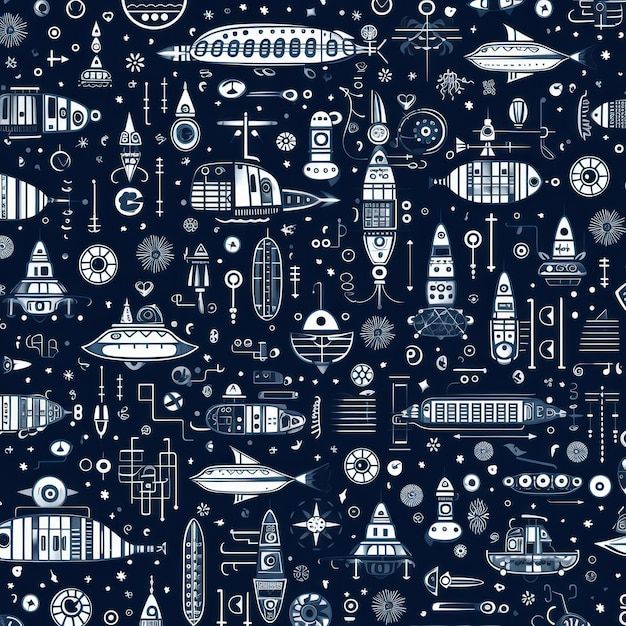
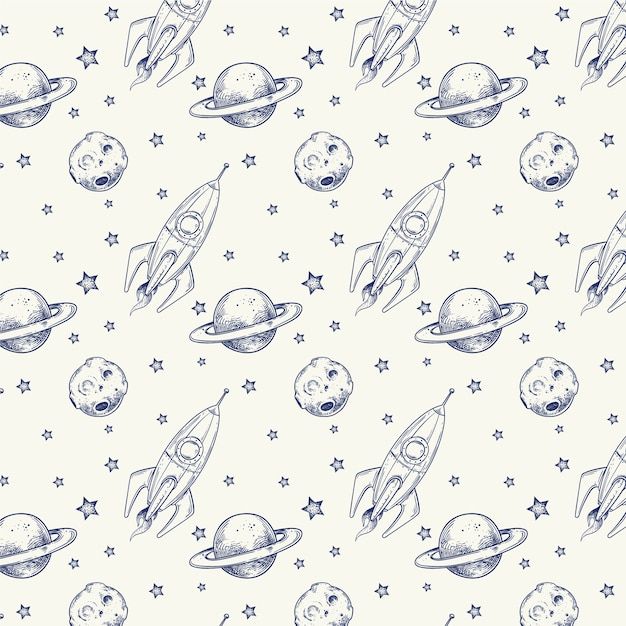
Rocket patterns belong to the space-theme category of novelty and conversational prints - a commercially durable children's product category alongside dinosaur, construction vehicle, and dinosaur motif patterns. The rocket's strong silhouette, cultural associations with adventure and exploration, and appeal to children's imagination give it reliable commercial traction in licensed and unlicensed product design. The aesthetic splits into two dominant traditions: the retro-futuristic style (drawing on 1950s-1960s science fiction illustration and Space Age design, featuring bullet-shaped metallic rockets with fins and flames), and the contemporary cartoon style (simplified, friendly forms suited to infant and younger children's products).
We use cookies to improve your experience and understand how PatternDesigners is used.
Rocket patterns belong to the space-theme category of novelty and conversational prints - a commercially durable children's product category alongside dinosaur, construction vehicle, and dinosaur motif patterns. The rocket's strong silhouette, cultural associations with adventure and exploration, and appeal to children's imagination give it reliable commercial traction in licensed and unlicensed product design.
The aesthetic splits into two dominant traditions: the retro-futuristic style (drawing on 1950s-1960s science fiction illustration and Space Age design, featuring bullet-shaped metallic rockets with fins and flames), and the contemporary cartoon style (simplified, friendly forms suited to infant and younger children's products).
The rocket motif in surface pattern has a distinctive set of visual conventions:
Rocket patterns most commonly use a tossed all-over layout: individual rocket motifs distributed at varied angles and scales across the tile, often mixed with smaller supporting elements (stars, planets, planets) to fill the ground. This structure provides visual variety while maintaining recognisability.
Directional upward-pointing arrangements (rockets all oriented vertically with nose-up) are a more ordered alternative; less common, more formal.
Space scene compositions (a large illustrative space landscape as a placement or panel print) represent a non-repeat alternative used on children's bedding and playroom products.
Retro-futuristic palette: Silver/metallic grey, red, navy, and white; referencing mid-century aerospace colour coding and vintage science fiction illustration. Typically bold, high-contrast, graphic.
Contemporary cartoon palette: Bright primary or secondary colours (red, blue, yellow rockets); pastel backgrounds; clean fills without texture. Designed for legibility on children's product applications.
Space environment palette: Dark navy or black ground with coloured rockets and white or metallic star/planet elements; nighttime space scene aesthetic.
Gender-coded variants: Blue/grey/green for conventional boys' product lines; pink and purple versions for gender-neutral or specifically girls' market positioning.
Rocket imagery entered Western popular visual culture with the Space Age and the Cold War space race: Sputnik (1957), Yuri Gagarin (1961), and the Apollo missions (1969) made rockets into cultural icons. The period from 1955 to 1975 established the visual vocabulary of space travel in illustration, toy design, and children's media - creating the retro-futuristic aesthetic that contemporary designers draw on when referencing the era.
Children's surface pattern design adopted rocket and space motifs early in this period. The combination of strong, simple silhouettes, cultural adventure associations, and science-literacy appeal has kept space themes a reliable novelty print category across generations.
In recent decades, renewed commercial interest in space exploration (SpaceX, renewed lunar missions, commercial space tourism) and the cultural legacy of films like Star Wars have sustained commercial demand for space-themed novelty prints.
Rocket patterns belong to the space-theme category of novelty and conversational prints - a commercially durable children's product category alongside dinosaur, construction vehicle, and dinosaur motif patterns.
Novelty
Rocket patterns most commonly use a tossed all-over layout: individual rocket motifs distributed at varied angles and scales across the tile, often mixed with smaller supporting elements (stars, planets, planets) to fill the ground. This structure provides visual variety while maintaining recognisability.
Celestial and Novelty
Retro-futuristic palette: Silver/metallic grey, red, navy, and white; referencing mid-century aerospace colour coding and vintage science fiction illustration. Typically bold, high-contrast, graphic.
Rocket imagery entered Western popular visual culture with the Space Age and the Cold War space race: Sputnik (1957), Yuri Gagarin (1961), and the Apollo missions (1969) made rockets into cultural icons.