Types
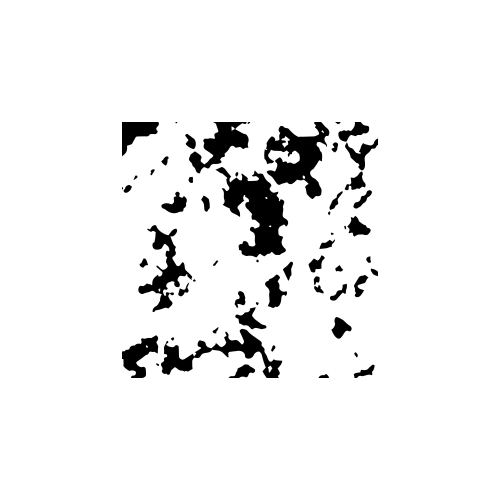 0Concrete pattern in surface design draws on the aesthetic of exposed concrete architecture - a visual language associated with Brutalism, modernism, urban environments, and industrial material honesty. As a texture reference, concrete provides a neutral, granular surface that functions as a background or structural element in surface design rather than as a decorative motif. Its commercial applications are primarily in interior materials (wallpaper, tile, printed flooring) and as a background texture in graphic design and stationery. The source available covers architectural and construction-focused concrete patterning rather than directly SPD-specific applications.
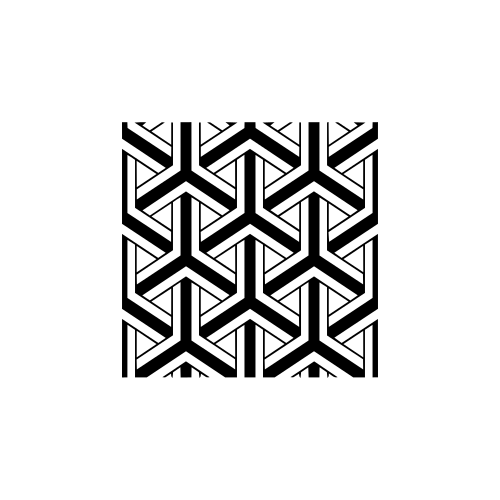 0Geometric pattern uses mathematical forms - triangles, squares, hexagons, circles, diamonds, and their combinations - as the primary structural and visual element. It is among the oldest and most widespread pattern categories in human decorative art, with major traditions in Islamic art, pre-Columbian textile design, Japanese textile design, and European architectural ornament. In contemporary surface pattern design, geometric pattern spans the full spectrum from rigorous mathematical tiling systems to loose, hand-drawn geometric aesthetics, and is commercially active across all market sectors.
 0Green is one of the most commercially significant colours in surface pattern design, with strong cultural associations with nature, growth, and renewal that make it a perennial in botanical, floral, and nature-inspired pattern. The green spectrum is exceptionally broad - from the yellow-green of chartreuse and lime through the blue-green of seafoam, jade, and emerald, to the grey-green of sage, olive, and moss. Each shade carries distinct commercial and cultural associations relevant to pattern positioning and market application.
 0Grey is a commercially dominant colour in surface pattern design, particularly in contemporary interiors and fashion, where its associations with restraint, sophistication, and modernity make it a neutral anchor for multi-pattern compositions. The grey spectrum ranges from near-white (gainsboro, platinum, silver) through mid-tone charcoal to near-black (graphite, lead). Critically, grey divides into cool greys (with blue or green undertones) and warm greys (with brown, pink, or red undertones) - a distinction that significantly affects how grey-based patterns read alongside other colours.
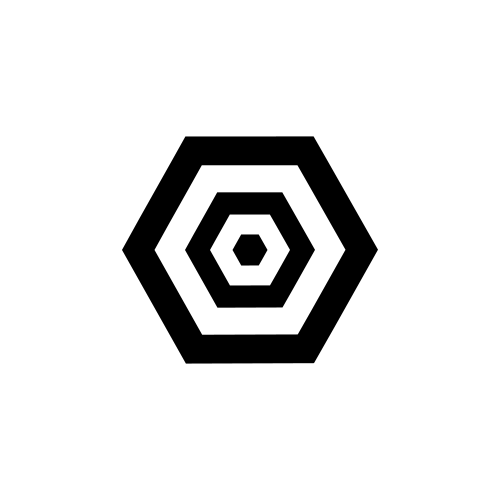 0The hexagon pattern is built from regular hexagons - six-sided polygons with equal sides and 120-degree internal angles. Three hexagons meet at each vertex, which accounts for the full 360 degrees and produces a mathematically stable, gapless tessellation. In surface pattern design, this structure appears in two primary forms: the pure geometric grid, and the nature-referencing honeycomb, where the hexagonal cells evoke beeswax construction. The hexagonal tessellation has mathematical properties that make it widely useful: it covers a plane surface with the least total perimeter for a given area (the honeycomb theorem), and circles inscribed within hexagonal cells achieve the densest possible two-dimensional packing. These structural efficiencies have contributed to the form's persistence across many decorative and applied design traditions.
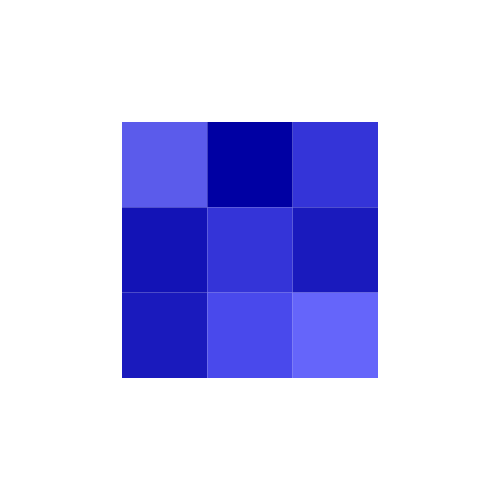 0Light blue pattern is a colour-led classification rather than a motif or structural type. Any pattern - geometric, floral, stripe, check, abstract - falls into this category when light blue is the dominant or defining colour. As a result, the category is commercially broad and crosses most pattern markets. Light blue carries strong and consistent psychological associations in Western commercial contexts: calm, clarity, trust, and openness. It is the colour of clear sky and clean water, and this associative weight makes it commercially stable across many product categories. First recorded as a colour term in English in 1915, light blue has a long commercial and cultural life in textiles, interiors, and product design.
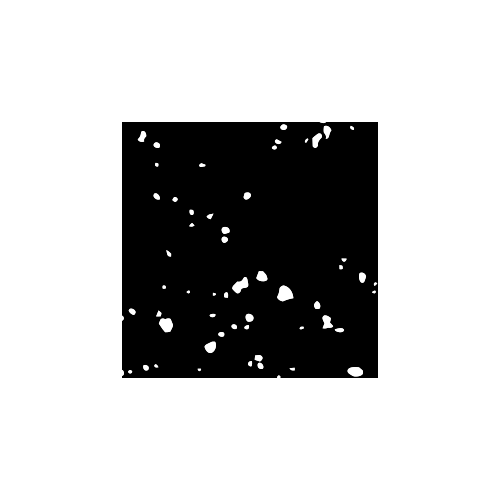 0Texture patterns occupy the boundary between surface pattern and material simulation. Their function is to add visual depth, tactile suggestion, and material character to flat surfaces. In surface pattern design, texture works both as a standalone aesthetic (small-scale all-over patterns that create a textural ground) and as an explicit simulation of specific materials - woven cloth, wood grain, stone, linen, canvas, leather, or natural fibre. The category is commercially significant in interior design, wallpaper, and substrate printing where the illusion of material quality is a purchasing driver.
 0White and off-white as dominant pattern colours produce surface designs with a distinctive restraint and clarity. In surface pattern design, white functions both as a ground colour (providing the base against which coloured motifs are seen) and as a primary design element in its own right - in tone-on-tone patterns, broderie anglaise-inspired cutwork effects, and minimalist single-colour repeats. The white spectrum is broader than it initially appears: dozens of commercially named off-whites with distinct undertones give designers significant palette range within the white family.
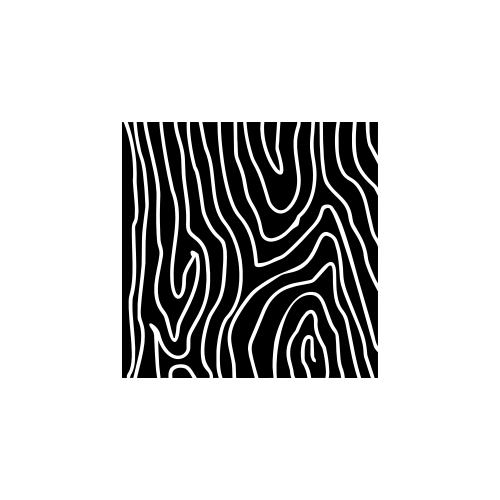 0Wood grain pattern is one of the most commercially significant natural texture categories in surface design. The visual structure of wood - parallel longitudinal fibres producing linear grain, annual growth rings producing concentric patterns in cross-section, and various figure effects (curly grain, bird's eye, tiger grain) produced by unusual growth conditions - provides a rich visual vocabulary for both decorative surface pattern and material simulation. Wood-effect printing on laminates, vinyl flooring, wallpaper, and furniture surfaces is a major commercial application driven by demand for the aesthetic quality of wood at lower cost.
You've reached the end
9 Types