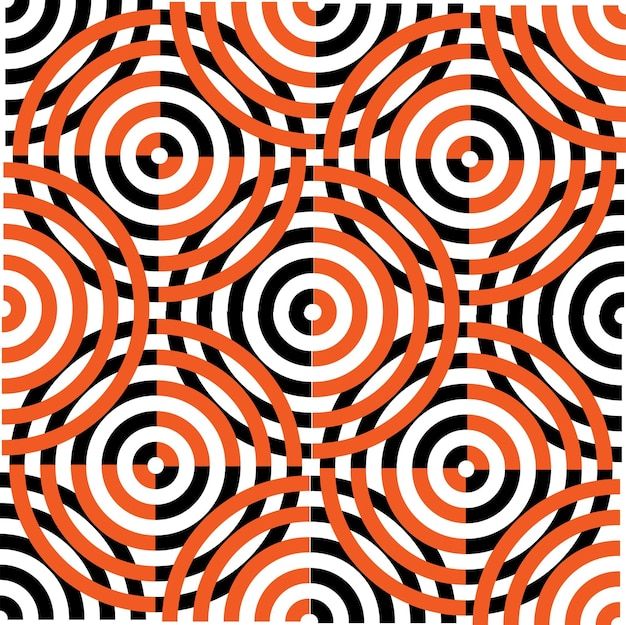
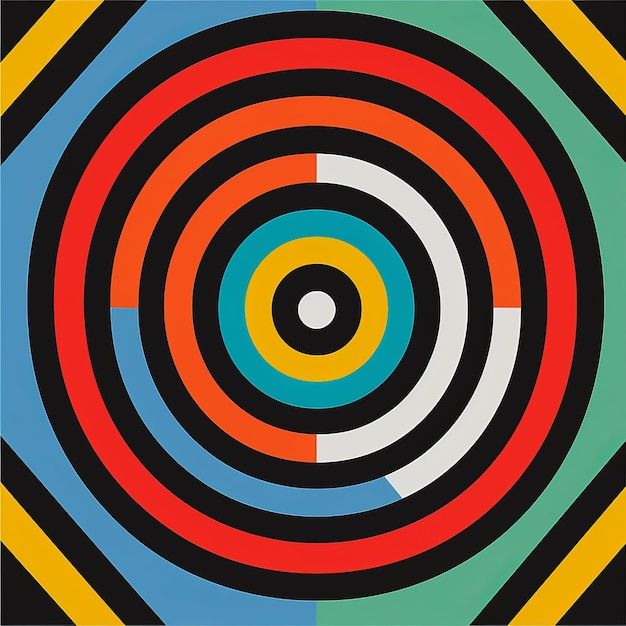
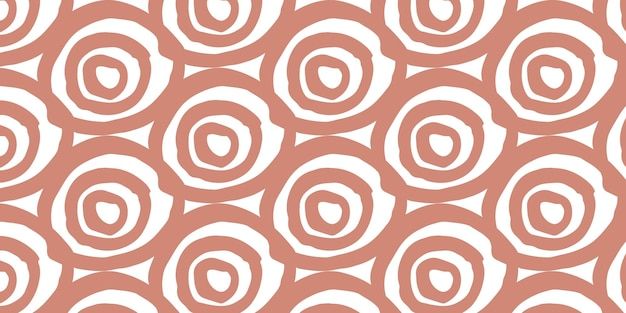
The bullseye is one of the simplest geometric pattern structures: a filled central circle surrounded by successive alternating rings. The result is a form with perfect radial symmetry that, under certain colour conditions, creates strong optical illusions - depth, pulsation, or apparent movement. Commercially positioned within the graphic, bold, and Op Art aesthetic registers.
We use cookies to improve your experience and understand how PatternDesigners is used.
The bullseye is one of the simplest geometric pattern structures: a filled central circle surrounded by successive alternating rings. The result is a form with perfect radial symmetry that, under certain colour conditions, creates strong optical illusions - depth, pulsation, or apparent movement. Commercially positioned within the graphic, bold, and Op Art aesthetic registers.
High-contrast colour pairings (black and white being the classic) maximise optical effect. The concentric ring structure reads clearly at distance and retains impact across scale variations. When multiple bullseye units are placed in close repeat, they create a secondary pattern of interacting optical fields.
Spot repeat: individual bullseye units placed at regular or offset intervals across the ground. The unit itself has perfect radial symmetry. Tile repeats can use single or multiple scaled bullseye units.
Black and white is the canonical combination for maximum optical impact. Coloured variants use two or more alternating hues across the rings. Tie-dye bullseye treatments produce irregular, diffused ring edges with organic colour gradation - a distinct aesthetic variant within the category.
The bullseye form appears across decorative art traditions: Welsh oak furniture used impressed dot-and-circle motifs as recurring surface decoration; antique crown glass produced characteristic thickened, bubbled centres in blown panes, creating accidental bullseye effects later used decoratively in glazed windows. In 20th-century design, the form was adopted by Op Art as a vehicle for perceptual experiments, particularly during the 1960s.
The bullseye is one of the simplest geometric pattern structures: a filled central circle surrounded by successive alternating rings. The result is a form with perfect radial symmetry that, under certain colour conditions, creates strong optical illusions - depth, pulsation, or apparent movement.
High-contrast colour pairings (black and white being the classic) maximise optical effect. The concentric ring structure reads clearly at distance and retains impact across scale variations. When multiple bullseye units are placed in close repeat, they create a secondary pattern of interacting optical fields.
Fashion prints (bold graphic collections) Op Art textile design Tie-dye (bullseye resist technique) Swimwear and sportswear graphics Homeware (ceramics, glassware) Wallpaper (graphic and feature panels)
Spot repeat: individual bullseye units placed at regular or offset intervals across the ground. The unit itself has perfect radial symmetry. Tile repeats can use single or multiple scaled bullseye units.
Bullseye / target (concentric ring sequence) Concentric circle (simplified, fewer bands) Dot-and-ring (reduced two-element form)
Black and white is the canonical combination for maximum optical impact. Coloured variants use two or more alternating hues across the rings. Tie-dye bullseye treatments produce irregular, diffused ring edges with organic colour gradation - a distinct aesthetic variant within the category.
The bullseye form appears across decorative art traditions: Welsh oak furniture used impressed dot-and-circle motifs as recurring surface decoration; antique crown glass produced characteristic thickened, bubbled centres in blown panes, creating accidental bullseye effects later used decoratively in glazed windows.
Geometric Pattern