Types
 1Art Deco is one of the most commercially significant historical styles in surface pattern design. Its geometric vocabulary, metallic sensibility, and associations with glamour and modernity make it a perennial category across fashion, interiors, wallpaper, and licensing. The style emerged from a collision of geometric abstraction, exotic ornamental traditions, and a deliberate celebration of contemporary materials and industrial production. It remains among the most recognisable and commercially active historical design movements.
 1Astrology pattern draws on the graphic language astrology uses to represent relationships between celestial bodies: symbolic glyphs for planetary "aspects" (angles between planets in a horoscope), the twelve zodiac signs grouped into four elemental sets, and - notably for surface pattern - the fact that many of these aspect angles correspond directly to regular star polygons (pentagram, heptagram, octagram, decagram, dodecagram, and more). The source is an astrology reference on aspect theory rather than a design source, so this page focuses on the visual/symbolic vocabulary it documents.
 1Bohemian pattern is defined by its source diversity - drawing simultaneously from Moroccan tilework, Indian block-print traditions, African mudcloth geometry, Native American and Southwestern weavings, and Eastern European folk embroidery. The unifying quality is not any single motif but palette discipline and a hand-made visual register. Home textiles represent the largest commercial market; mandala patterns form the most commercially active subcategory.
 0The bullseye is one of the simplest geometric pattern structures: a filled central circle surrounded by successive alternating rings. The result is a form with perfect radial symmetry that, under certain colour conditions, creates strong optical illusions - depth, pulsation, or apparent movement. Commercially positioned within the graphic, bold, and Op Art aesthetic registers.
 0Butterfly pattern has a long history in both fine decorative arts and commercial surface design. As a motif, the butterfly offers symmetry, colour complexity, wing-surface variation, and symbolic richness - making it commercially active across luxury fashion, interior wallpaper, scarves, upholstery, and licensing. The historical trajectory of butterfly pattern runs from scientific illustration (E.A. Seguy, 1925) through haute couture (Schiaparelli, McQueen) to contemporary wallpaper and textiles. Moths are frequently treated as aesthetic extensions of butterfly pattern, with their own design vocabulary.
 0Circle pattern is a broad geometric category in surface design, encompassing everything from the commercial simplicity of the polka dot to the sacred geometry associations of the Flower of Life overlapping-circles grid. The circle as a design element is commercially universal - it appears in children's textiles, modernist fashion prints, home decor, jewellery, and stationery. The overlapping circles grid specifically carries documented use from ancient Assyrian decoration through Roman Empire architecture, Islamic geometric art, and Gothic stonework - giving it both deep historical roots and active contemporary market relevance.
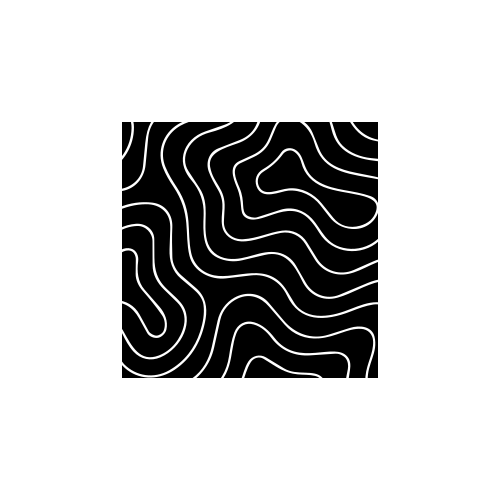 0Contour patterns draw from two distinct visual traditions sharing the same vocabulary of lines: cartographic contour mapping (where curved parallel lines reveal terrain relief) and contour drawing in fine art (where line defines the mass and edges of a subject without shading). Both traditions translate into surface pattern design as linear compositions with a characteristic structural and depth-suggesting aesthetic.
 1Damask is simultaneously a weaving technique and a surface pattern aesthetic. As a woven fabric, it is defined by its structure: a warp-faced satin pattern woven against a weft-faced satin ground using the same thread set, producing a reversible fabric where the pattern appears on both sides but in inverse tone. As a pattern aesthetic, damask refers to the large-scale ornamental vocabulary - medallions, scrolls, florals, and architectural forms - that developed through this technique. In surface pattern design, damask motifs are reproduced by printing as well as weaving, and are commercially active in wallpaper, home textiles, and licensing across heritage, formal, and ironically-deployed contexts.
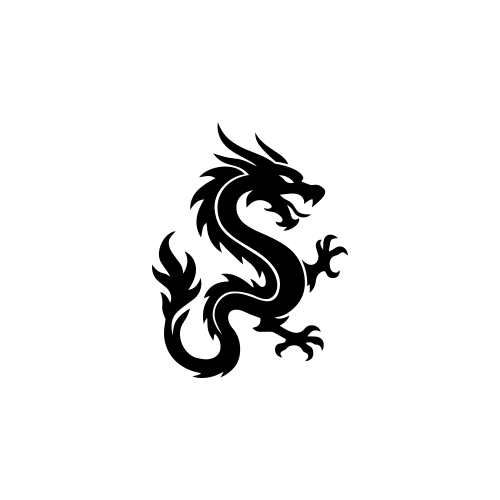 0Dragon pattern in surface design is dominated by East Asian iconographic traditions - particularly the Chinese imperial dragon with its coiled body, five claws, and accompanying symbolic elements (flaming pearl, clouds, waves). This tradition connects to one of the most historically significant applications of surface pattern design: the ceremonial robes of Chinese, Korean, and Japanese imperial courts, in which dragon motifs were encoded symbols of rank and political authority. In contemporary surface design, dragon pattern carries associations with power, mythology, and Asian cultural heritage, and is commercially active across fashion, wallpaper, licensing, and gift products.
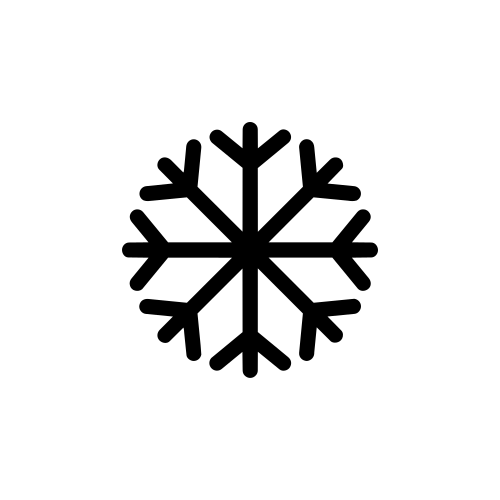 0Ice patterns in surface pattern design take their visual vocabulary from natural frost and ice crystal formations. The branching, fern-like structures that form when water freezes slowly - across glass, on wet surfaces, in the natural environment - produce distinctive geometric forms that have direct application in textile and wallpaper design. These structures sit between the organic and the geometric: they follow mathematical rules (dendritic branching, hexagonal symmetry in ice crystals) but result in forms that appear organic and irregular. The ice pattern category covers a range from literal representations of frost ferns and window ice to stylised geometric interpretations of crystalline forms, blending into the broader winter and snowflake pattern traditions.
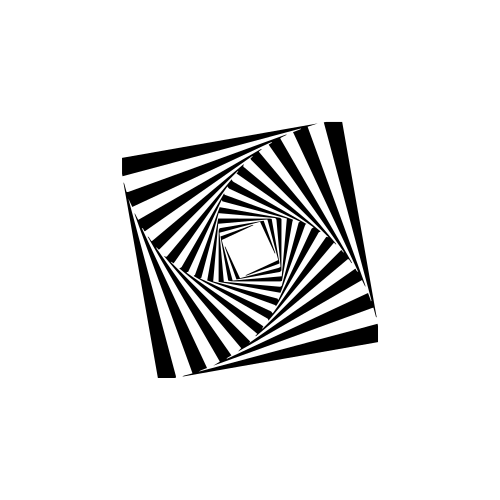 0Illusion patterns exploit the perceptual mechanisms of human vision. By carefully arranging shapes, contrasts, and line orientations, a designer can make a flat 2D surface appear three-dimensional, appear to be in motion, or appear to contain spatial depth. The technique is distinct from representational trompe l'oeil (painted imitation of objects) in that illusion patterns typically use abstract geometric forms rather than pictorial imagery. The commercial territory covers a range from bold Op Art-influenced fashion prints to subtle structural depth effects in wallpaper and interior textiles. The key technical elements are: strong tonal contrast (often black and white), precise geometric structure, and controlled spatial organisation.
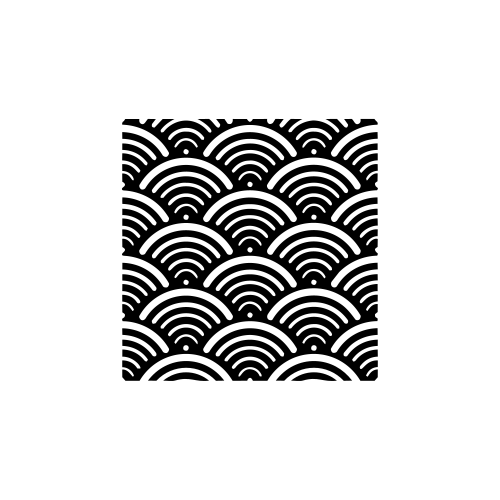 0"Oriental pattern" is an industry umbrella term rather than a precise technical category. In commercial contexts it typically refers to patterns drawing on the visual vocabulary of oriental carpets (Turkish, Persian, Caucasian, Central Asian, and Chinese), on Chinese and Japanese decorative motifs, or on the broader Orientalist aesthetic that shaped European design from the 16th century onwards. The term encompasses designs of considerable complexity and cultural depth - from the strict geometric traditions of Anatolian Seljuq carpet design (13th century) through the floral elaboration of Safavid Persian court carpet to the chinoiserie-influenced surface patterns of 18th-century European textiles. In contemporary commercial use, it typically signals formal, richly decorated, tradition-referencing pattern design. Note on terminology: "Oriental" as a descriptor has been contested in some cultural and academic contexts; "Islamic", "Persian", "Anatolian", "Central Asian", or specific regional names are often more precise when attribution is known.
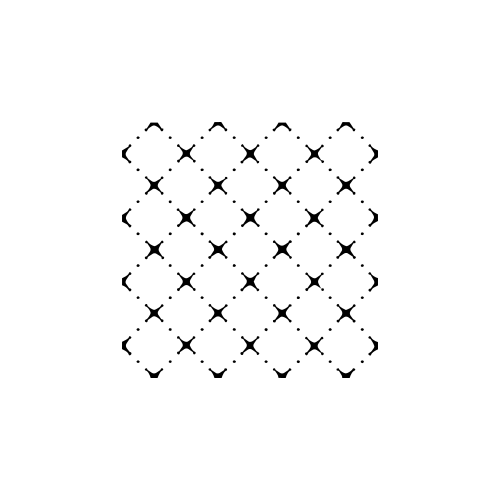 0A pattern is any regular, predictable arrangement in which elements repeat according to a consistent rule. In surface pattern design, "pattern" refers specifically to a decorative design applied to a two-dimensional surface through repeating visual elements - the primary working material of the surface pattern designer. The concept unifies highly diverse visual territory: a geometric wallpaper grid, a botanical print repeat, and a houndstooth check are all patterns in the full sense - each is governed by translational symmetry and a defined repeat unit. The word "pattern" in the decorative arts context specifically designates repeating ornamental designs manufactured for surfaces - ceramics, textiles, and wallpaper are the canonical application contexts.
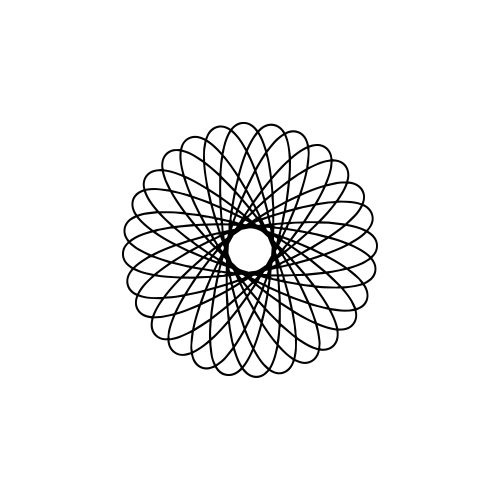 0Radial patterns organise their design elements around a central origin point, from which motifs, lines, or shapes extend outward in all directions. The structure produces a strong visual focus and an inherent sense of balance and rhythm. Radial composition is one of the most ancient and cross-cultural structural principles in decorative art, appearing in mandalas, rose windows, Islamic geometric mosaics, and natural forms.
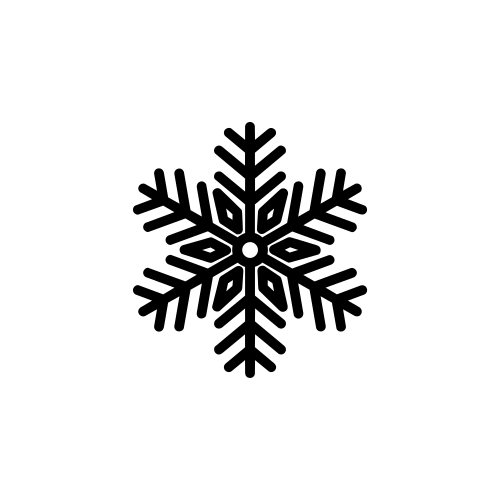 0Snow patterns in surface pattern design are primarily driven by the snowflake motif and its variants. The snowflake is one of the most geometrically distinctive natural forms - its strict sixfold symmetry, intricate branching, and infinite variation within a fixed structural rule make it an enduringly rich source for surface pattern. Snow patterns are strongly seasonal, with commercial demand concentrated in autumn/winter product ranges, Christmas collections, and winter homeware.
 0The star is a radial geometric motif formed from a star polygon or polygonal compound, named for its resemblance to the diffraction spikes of astronomical stars. Stars appear across heraldry, religious iconography, flags, and badges, with different point-counts carrying distinct and often unrelated symbolic meanings depending on the culture and context. As a surface pattern motif, the star's appeal comes from this combination of simple, highly legible geometry and layered symbolic weight.
 0Swirl and spiral patterns draw on one of the most fundamental geometric structures in mathematics and nature. The spiral - a curve that emanates from a point and moves progressively further away as it rotates - appears across natural forms (nautilus shells, sunflower seed heads, unfurling ferns) and across cultures and millennia of decorative art (Celtic triple-spirals, Islamic arabesque scrollwork, Art Nouveau organic curves). In surface pattern design, swirl and spiral forms create a sense of dynamic flow and movement, and are particularly associated with fluid, organic, or energetic aesthetic directions.
You've reached the end
17 Types