Types
 0The fleur-de-lis is a symmetrical three-part form: a central upward-pointing petal flanked by two outward-curving petals, all bound at the base by a horizontal band or ring. As a surface pattern, it appears in seamless all-over repeats, formal damask compositions, trellis grids, and contemporary minimalist interpretations. Its heritage associations - French royalty, European heraldry, Christian iconography - give it a luxury and classical positioning that remains commercially active across wallpaper, home furnishings, and fashion.
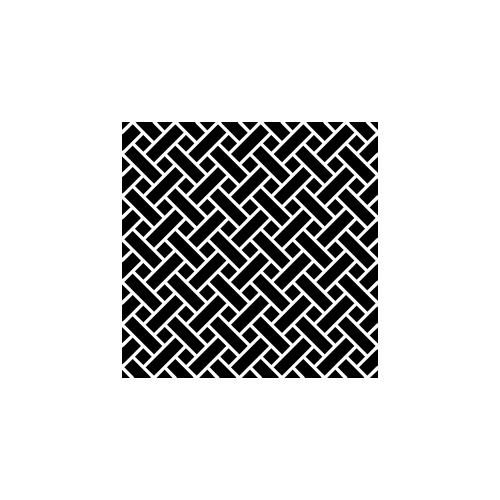 0Lattice pattern is derived from the visual and structural form of latticework - a framework of criss-crossed strips (in wood, metal, or other materials) that form an open grid or woven-diagonal pattern. As a surface pattern type, lattice uses intersecting diagonal or orthogonal lines or bands to create a regular grid with defined open areas (cells) between the crossing points. The lattice is one of the most fundamental structural patterns in surface design - it appears in tile and textile traditions worldwide, provides a compositional scaffold for more complex patterns, and functions both as a background framework and as a primary motif in its own right.
 0The quatrefoil (from Old French: "four leaves") is a specific geometric shape: four circles of equal diameter, each overlapping its neighbours, arranged so their centres define a square. The resulting outline is a four-lobed form with pointed intersections between adjacent lobes - resembling a four-leaf clover, a four-petalled flower, or a rounded cross. As a decorative motif it has been used continuously across at least 1,500 years, appearing in early Christian architecture, Islamic design, Gothic tracery, Renaissance decorative arts, and contemporary interiors. It carries consistent cultural associations with heritage, formality, and luxury, positioning it commercially as a premium interior and fashion motif.
 0The trellis pattern draws its identity from the architectural garden structure of the same name: an open, interlocking grid of bamboo, timber, or metal that provides a framework for climbing foliage. Translated into surface pattern, the trellis becomes a geometric lattice motif - either used as a primary grid structure with foliage elements filling the cells, or simplified to a geometric linear pattern without botanical content. The pattern sits at the intersection of geometric structure and garden/botanical aesthetics, and is strongly associated with home furnishing rather than apparel.
You've reached the end
4 Types