Types
 4Asymmetry in surface pattern design refers to the deliberate avoidance of symmetrical arrangement. Rather than cancelling visual energy, an asymmetric pattern harnesses contrast, uneven spacing, and varied visual weights to create compositions that feel dynamic and engaging. It is a structural choice rather than a specific pattern style, applicable across a wide range of motif types and aesthetics.
 0A directional pattern is one where the motifs or compositional elements read correctly only from one or a limited set of angles. Rotating or inverting the fabric makes the pattern appear wrong - animals face downward, flowers hang upside down, text becomes unreadable. This property is intrinsic to many figurative, scenic, and novelty prints and has direct practical implications for fabric cutting, garment making, and quilt construction. Directionality is a structural classification rather than an aesthetic category: a pattern is either directional or it is not.
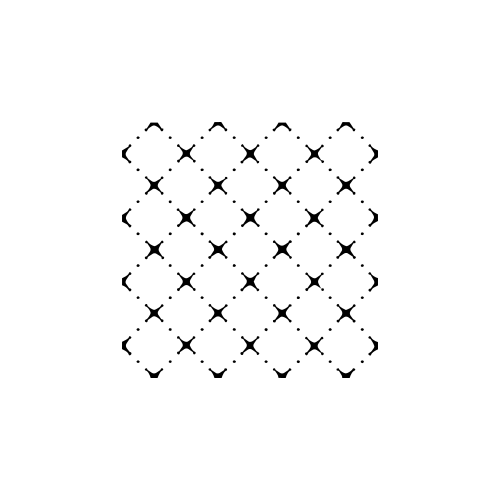 0A pattern is any regular, predictable arrangement in which elements repeat according to a consistent rule. In surface pattern design, "pattern" refers specifically to a decorative design applied to a two-dimensional surface through repeating visual elements - the primary working material of the surface pattern designer. The concept unifies highly diverse visual territory: a geometric wallpaper grid, a botanical print repeat, and a houndstooth check are all patterns in the full sense - each is governed by translational symmetry and a defined repeat unit. The word "pattern" in the decorative arts context specifically designates repeating ornamental designs manufactured for surfaces - ceramics, textiles, and wallpaper are the canonical application contexts.
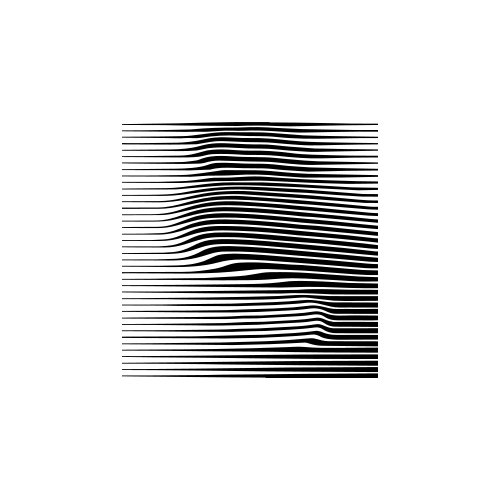 0Natural patterns are regular structures produced by physical, biological, and mathematical processes operating in living organisms and non-living physical systems. For surface pattern designers, patterns in nature are among the most important reference sources - providing the visual vocabulary of organic geometry, the colour relationships of natural pigmentation, and the structural logic of systems that repeat at multiple scales. The recognition that all natural patterns arise from a small set of underlying mechanisms - symmetry, reaction-diffusion, Fibonacci sequence, fractal iteration - gives surface designers a conceptual framework for generating and analysing naturally-inspired surface design work.
 0Symmetry is the mathematical and structural foundation of all repeating surface pattern. Every seamless repeat pattern uses at least translational symmetry - the ability to shift the pattern by a fixed distance and have it look identical. More complex patterns additionally use reflection (mirror), rotation, or glide reflection symmetry to create richer visual arrangements. Understanding symmetry operations is a core competency in surface pattern construction, enabling designers to build complex patterns from simple element repetitions.
You've reached the end
5 Types