Army pattern (camouflage) originated as a military concealment technology and has become one of the most commercially active print categories in streetwear, fashion, and licensed product design. The pattern carries persistent cultural associations with military identity, subcultural rebellion, and anti-establishment positioning. It cycles reliably through mainstream fashion while maintaining a permanent baseline presence in workwear, sportswear, and streetwear.
We use cookies to improve your experience and understand how PatternDesigners is used.
Army pattern (camouflage) originated as a military concealment technology and has become one of the most commercially active print categories in streetwear, fashion, and licensed product design. The pattern carries persistent cultural associations with military identity, subcultural rebellion, and anti-establishment positioning. It cycles reliably through mainstream fashion while maintaining a permanent baseline presence in workwear, sportswear, and streetwear.
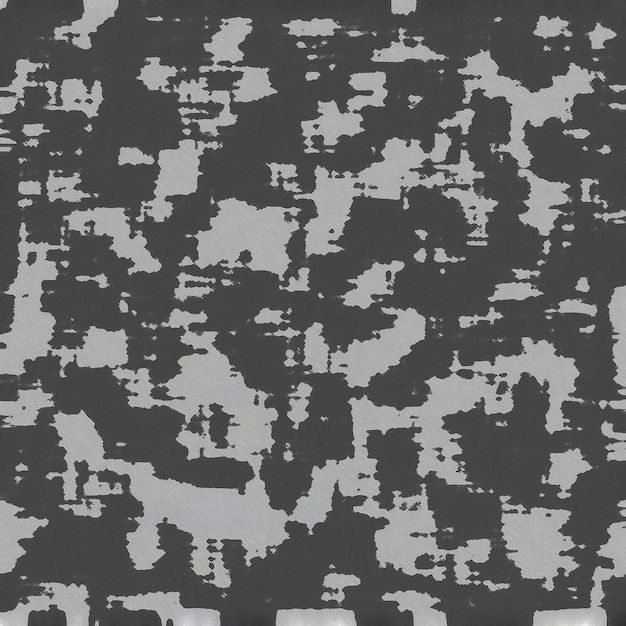
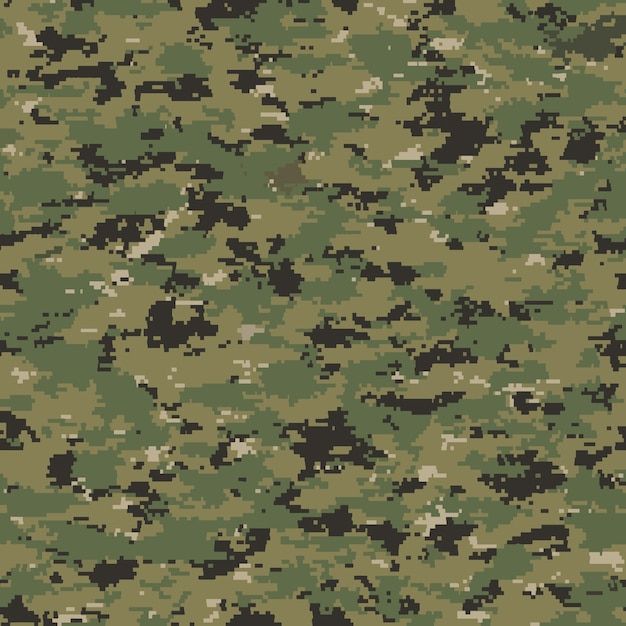
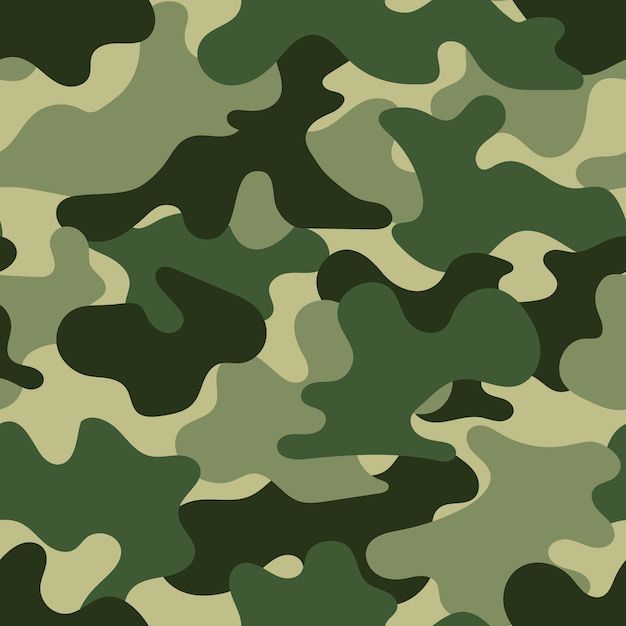
Traditional camouflage uses irregular patches of earth-tone colour - greens, browns, tans, greys, and blacks - creating a disruptive multi-value surface that resists reading as a single shape from a distance. Patches are organic in form with no repeating geometric structure apparent at normal viewing scale. Digital camouflage (developed from the 1990s) uses pixelated square modules at multiple scales, creating a fractal-like colour breakup. Flecktarn camouflage (Germany) uses small irregular dots in overlapping colour layers. All variations share the principle of value fragmentation across the surface.
Traditional camouflage is an irregular all-over surface - the repeat is deliberately obscured by the chaotic distribution of colour patches. In printed fashion contexts, the structural repeat is typically large to preserve the visual randomness. Digital camouflage is grid-based at multiple scales, with pixel clusters in two or three sizes creating a modular but non-uniform overall pattern. Scale is a key variable - military camouflage is engineered at specific scales for viewing distance; fashion adaptations use modified scales for garment and product context.
Military camouflage uses khaki, olive green, dark green, brown, tan, grey, and black calibrated to terrain type (woodland, desert, urban, arctic). The US Army Universal Camouflage Pattern used Desert Sand 500, Urban Gray 501, and Foliage Green 502 - a multi-environment palette. Fashion versions extend the structure into any colourway while retaining the disruptive-patch vocabulary. Pink camouflage, blue camouflage, and floral-overlay camouflage are commercially established fashion variants. High-contrast black-and-white camouflage also appears as a fashion category.
Military camouflage was formalised during World War I, when armies recruited artists and designers as camoufleurs to develop disruptive pattern systems. In 1919, a "Dazzle Ball" in London celebrated WWI camouflage through fashion - one of the earliest documented connections between military design and civilian dress. Marimekko (Finland) was among the early fashion designers to incorporate camouflage-adjacent print language in the 1960s. Andy Warhol produced a camouflage series in 1986, framing the pattern as a subject of surface and concealment in fine art. Major fashion houses adopted camouflage from the late 1990s: Dior, Louis Vuitton (Marc Jacobs era), Chanel, Tommy Hilfiger, Dolce & Gabbana, Issey Miyake, Giorgio Armani, and Yves Saint Laurent. Streetwear brands established camouflage as a cultural foundation: A Bathing Ape (BAPE Ape Camo), Stone Island, Stüssy, and Maharishi. The pattern carries persistent political resonance as both military symbol and, in anti-war and countercultural contexts, a sign of dissent. The US Army Universal Camouflage Pattern (UCP), introduced in 2004, was itself replaced by the Operational Camouflage Pattern by 2019 - illustrating that even official military camouflage is subject to revision.
Army pattern (camouflage) originated as a military concealment technology and has become one of the most commercially active print categories in streetwear, fashion, and licensed product design.
Traditional camouflage uses irregular patches of earth-tone colour - greens, browns, tans, greys, and blacks - creating a disruptive multi-value surface that resists reading as a single shape from a distance. Patches are organic in form with no repeating geometric structure apparent at normal viewing scale.
Geometric
Traditional camouflage is an irregular all-over surface - the repeat is deliberately obscured by the chaotic distribution of colour patches. In printed fashion contexts, the structural repeat is typically large to preserve the visual randomness.
Military camouflage uses khaki, olive green, dark green, brown, tan, grey, and black calibrated to terrain type (woodland, desert, urban, arctic). The US Army Universal Camouflage Pattern used Desert Sand 500, Urban Gray 501, and Foliage Green 502 - a multi-environment palette.
Military camouflage was formalised during World War I, when armies recruited artists and designers as camoufleurs to develop disruptive pattern systems. In 1919, a "Dazzle Ball" in London celebrated WWI camouflage through fashion - one of the earliest documented connections between military design and civilian dress.
Animal Pattern, Geometric Pattern, and Abstract Pattern