Types
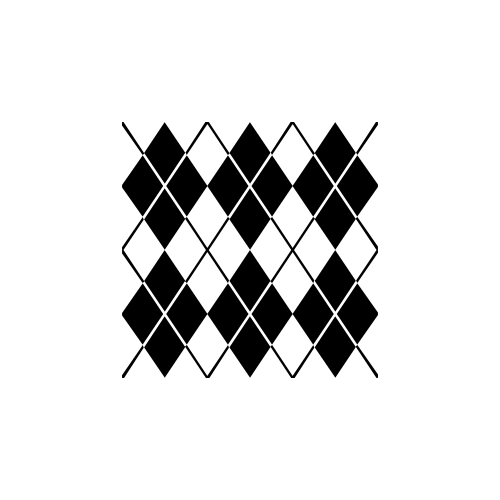 0Argyle is one of the most commercially durable geometric patterns in British textile design. It is foundational to sock, jumper, and golf knitwear, and cycles regularly through fashion and sports apparel. The pattern has strong heritage associations - Scotland, golf culture, preppy dress - but adapts readily to contemporary colourways and scaled-up fashion interpretations.
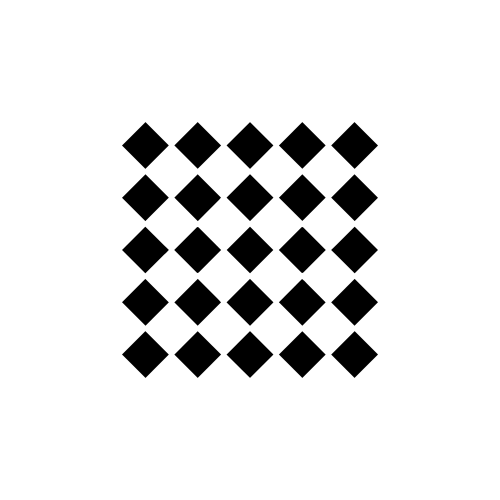 0Diamond pattern is a structural term in surface pattern design: it describes any composition in which the primary visual elements are aligned along 45° diagonal axes rather than horizontal and vertical ones. The diamond (rotated square) is among the most versatile geometric forms in surface design - equally present in architectural stonework, woven textiles, stained glass, playing cards, and fashion print. As a structural category it encompasses both the simple single-colour diamond grid and complex multicolour arrangements such as argyle, harlequin, and lozenge compositions.
 0The term "digital pattern" is used in two distinct industries with incompatible meanings. In apparel manufacturing, a "digital pattern" means a garment construction pattern (a 2D template for cutting fabric) produced using CAD software - this is the meaning addressed in the available source. In surface pattern design, "digital pattern" refers to the creation method: repeat patterns designed using software such as Adobe Illustrator, Photoshop, Procreate, or specialist pattern tools rather than by physical media. This page addresses the SPD meaning. Digital creation tools have become the dominant production method in surface pattern design. Most professional pattern designers now work digitally for some or all of their workflow - either creating artwork digitally from the start, or digitising hand-made artwork for repeat production. The rise of digital tools has expanded who can produce commercial surface pattern and has enabled print-on-demand platforms that allow individual designers to sell directly to print customers.
 0The harlequin pattern is composed of repeating diamonds (or elongated diamond shapes standing on point) in alternating contrasting colours or values. Its origin lies specifically in the costume of the Harlequin (Arlecchino) character from the Italian Commedia dell'arte tradition, whose distinctive patchwork of multi-coloured diamond or lozenge-shaped fabric became one of the most recognised costume motifs in European popular culture. The pattern is a subset of the broader Diamond Pattern and Check Pattern family, distinguished by its theatrical origin and its characteristic use of high contrast, multiple colours, or bold two-tone compositions.
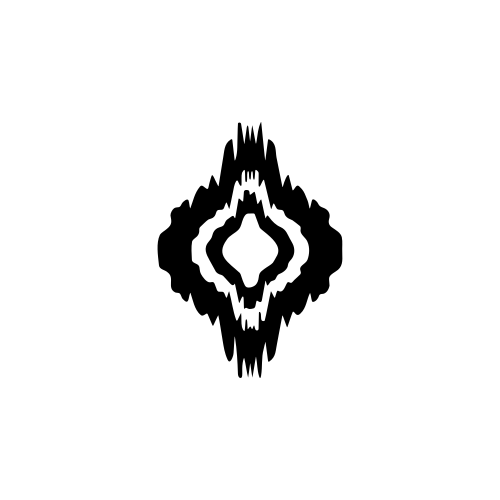 0Ikat is a resist-dyeing technique in which the yarn - warp, weft, or both - is bound and dyed before the fabric is woven. Unlike batik, which applies resist to finished cloth, ikat applies resist to the thread before weaving. The bound portions of yarn resist the dye; when the bindings are removed and the yarn is woven, the pre-dyed pattern appears in the cloth. Because the alignment of dyed yarn sections during weaving is never perfectly precise, ikat produces a characteristic soft-edged or slightly blurred version of the intended pattern - this "ikat blur" or "ikat feathering" is the defining visual characteristic of the technique and a primary aesthetic marker in ikat-inspired surface design. The word "ikat" derives from the Malay-Indonesian mengikat - "to tie" or "to bind."
 0A simple repeating pattern is a design in which one or more motifs are systematically duplicated to create an infinitely continuous surface. The repeat unit - the smallest tile that contains the complete design - is placed according to a layout rule that governs how tiles relate to each other spatially. Understanding these layout rules is considered one of the core technical competencies of surface pattern design. Once motifs are established, a designer can produce multiple coordinating patterns by applying different repeat layouts to the same elements.
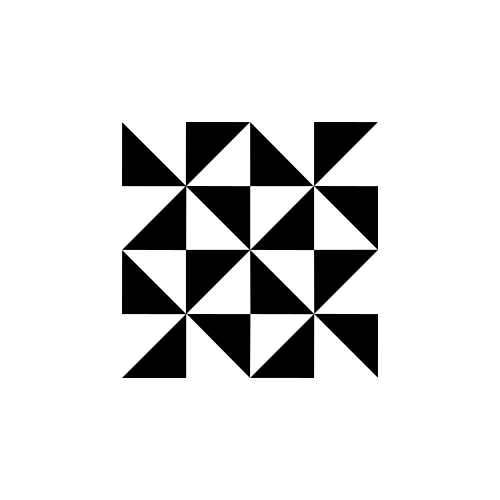 0Triangle patterns exploit the fundamental visual properties of the three-sided polygon: directionality (a triangle always points somewhere), the visual contrast between its flat base and sharp apex, and its ability to tile surfaces perfectly with no gap or overlap. In surface pattern, triangles function both as individual repeated motifs and as the structural unit of more complex geometric arrangements. The motif's associations - with stability, power, hierarchy, and dynamic energy - make it a versatile tool across a wide range of design contexts.
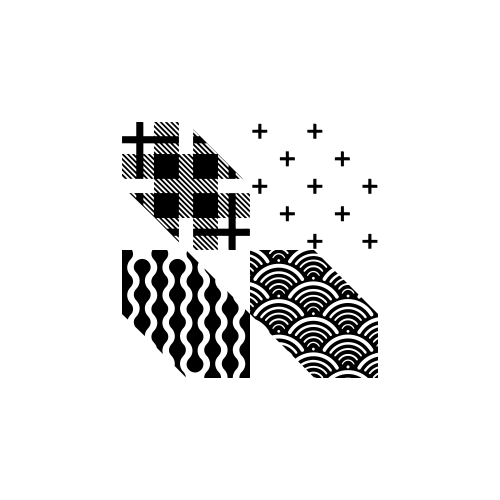 0A repeat pattern is any surface design in which a tile (or repeat unit) tessellates seamlessly across a surface. The type of repeat defines the geometric rule by which tiles relate to each other. Different repeat structures produce distinct visual rhythms and suit different markets and applications. In a pattern collection, multiple repeat types are typically used across the hero pattern and its coordinating designs to create variety and hierarchy within a unified colour and motif vocabulary.
You've reached the end
8 Types