Types
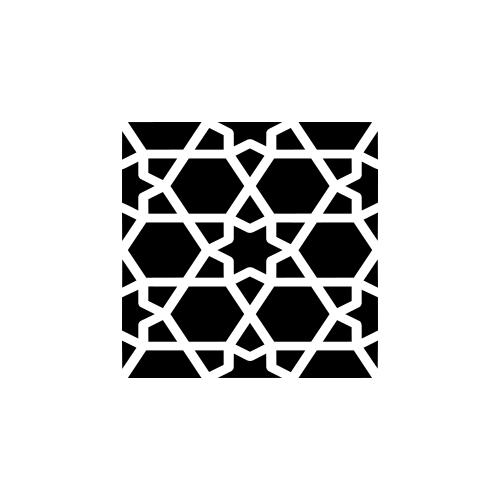 0Arabesque is among the most historically significant and technically sophisticated surface pattern traditions in world design history. Its defining properties - continuous interlacing scrollwork, organic branching structure, and infinite repeatability - make it distinctively suited to all-over surface application. The pattern appears across textiles, tile, metalwork, manuscript illumination, architectural decoration, and wallpaper, and remains commercially active in luxury interiors and premium textile markets.
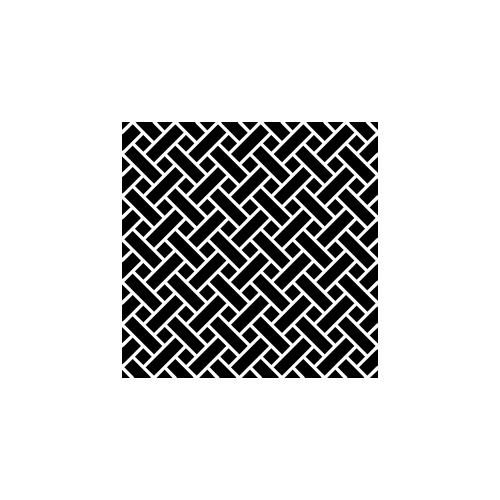 0Lattice pattern is derived from the visual and structural form of latticework - a framework of criss-crossed strips (in wood, metal, or other materials) that form an open grid or woven-diagonal pattern. As a surface pattern type, lattice uses intersecting diagonal or orthogonal lines or bands to create a regular grid with defined open areas (cells) between the crossing points. The lattice is one of the most fundamental structural patterns in surface design - it appears in tile and textile traditions worldwide, provides a compositional scaffold for more complex patterns, and functions both as a background framework and as a primary motif in its own right.
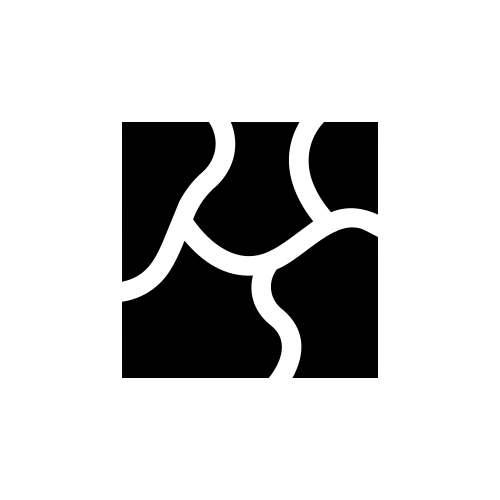 0Mosaic pattern refers to surface designs that either replicate or reference the visual appearance of traditional mosaic - artworks and decorative surfaces made from small pieces of coloured stone, glass, ceramic, or other materials (tesserae) set in mortar or plaster. As a surface pattern category, mosaic pattern encompasses: direct simulation of tesserae arrangements (small square or irregular coloured tile-like units); geometric tile compositions (particularly Islamic zellij and Byzantine mosaic traditions); and the broader visual aesthetic of tessellated coloured surfaces. Mosaic pattern is commercially active in tile design, printed wallpaper and fabric, and as an art-historical reference in luxury and heritage surface design.
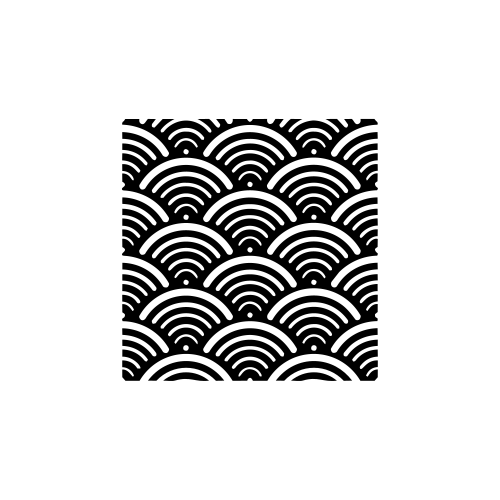 0"Oriental pattern" is an industry umbrella term rather than a precise technical category. In commercial contexts it typically refers to patterns drawing on the visual vocabulary of oriental carpets (Turkish, Persian, Caucasian, Central Asian, and Chinese), on Chinese and Japanese decorative motifs, or on the broader Orientalist aesthetic that shaped European design from the 16th century onwards. The term encompasses designs of considerable complexity and cultural depth - from the strict geometric traditions of Anatolian Seljuq carpet design (13th century) through the floral elaboration of Safavid Persian court carpet to the chinoiserie-influenced surface patterns of 18th-century European textiles. In contemporary commercial use, it typically signals formal, richly decorated, tradition-referencing pattern design. Note on terminology: "Oriental" as a descriptor has been contested in some cultural and academic contexts; "Islamic", "Persian", "Anatolian", "Central Asian", or specific regional names are often more precise when attribution is known.
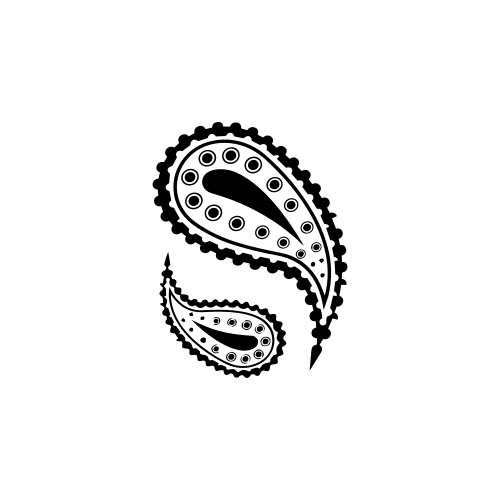 0Paisley is a curved, teardrop-shaped motif with a characteristic bent or curved upper end. The motif originated in Iranian and Persian decorative art - where it is called boteh or buta - and entered the European market through the importation of Kashmir shawls from the 17th century onwards. Its English name comes from Paisley, the Scottish town whose Jacquard-loom weavers became the dominant European producers of paisley-pattern fabric in the 19th century. Paisley is one of the most commercially enduring pattern types in Western fashion, with documented presence from early 19th-century bandanas through to continuous contemporary production. It is known by different names in different cultures: "mango" in most Indian and South Asian languages; "cucumbers" in Russia; "ham hock pattern" in China; "boteh," "cachemire," or "palme" in French design vocabulary.
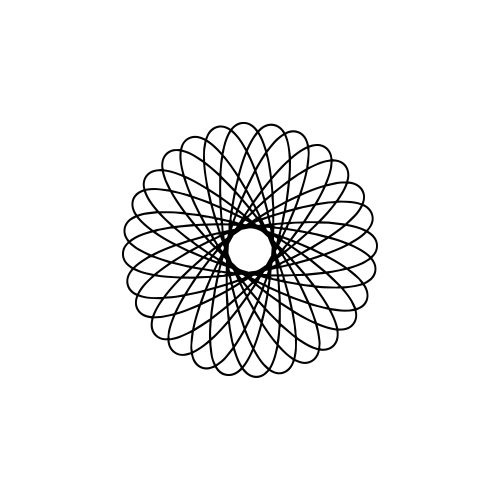 0Radial patterns organise their design elements around a central origin point, from which motifs, lines, or shapes extend outward in all directions. The structure produces a strong visual focus and an inherent sense of balance and rhythm. Radial composition is one of the most ancient and cross-cultural structural principles in decorative art, appearing in mandalas, rose windows, Islamic geometric mosaics, and natural forms.
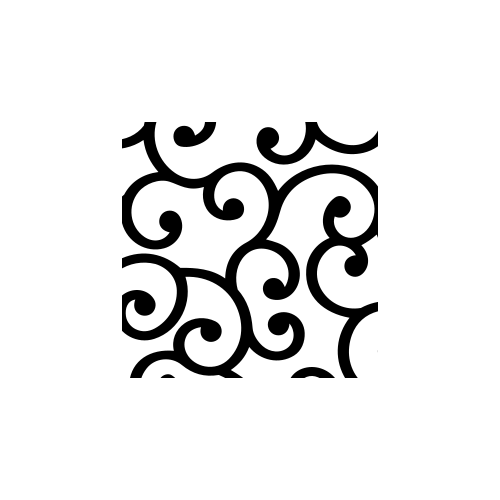 0The scroll pattern is an ornamental system built from the logic of plant growth: a continuous stem that branches, curls, and spirals, producing a flowing, all-over structure that can fill any surface without obvious repeat. Unlike grid-based geometric patterns, scroll patterns follow organic rhythms - mirroring the way vines, tendrils, and climbing plants ramify through space. This structural flexibility has made scroll patterns one of the most versatile and durable motif traditions in decorative history. They appear as architectural borders, woven textile structures, painted ceramic ornament, carved stone relief, and printed wallpaper. In surface pattern design, they translate naturally into all-over repeating structures with strong commercial applications across wallpaper, furnishing fabric, fashion, and heritage design reproduction.
 0Symmetry is the mathematical and structural foundation of all repeating surface pattern. Every seamless repeat pattern uses at least translational symmetry - the ability to shift the pattern by a fixed distance and have it look identical. More complex patterns additionally use reflection (mirror), rotation, or glide reflection symmetry to create richer visual arrangements. Understanding symmetry operations is a core competency in surface pattern construction, enabling designers to build complex patterns from simple element repetitions.
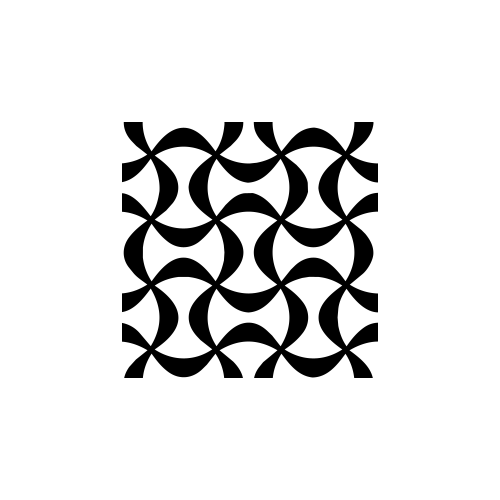 0Tessellation is the covering of a surface with one or more geometric shapes so that they fit together with no gaps and no overlaps. A periodic tiling repeats regularly; a regular tessellation uses identical regular-polygon tiles meeting identically at every corner. Only three shapes can tile a plane on their own this way: the equilateral triangle, the square, and the regular hexagon. Semi-regular tessellations combine more than one regular polygon while keeping the same arrangement at every vertex - there are eight of these. Beyond regular and semi-regular tiling, tessellations can also be built from irregular polygons, pentagons, or almost any interlocking shape, as popularised by M. C. Escher's animal- and figure-shaped tiles.
You've reached the end
9 Types